What Is Email Marketing? The Complete 2025 Guide
Email marketing is the practice of sending targeted, permission-based emails to a list of subscribers to build relationships, nurture leads, and drive measurable business outcomes. It is the highest-ROI digital marketing channel available — returning an average of $36 for every $1 spent, consistently outperforming paid ads, social media, and SEO on direct revenue attribution.
Quick Answer: Email marketing = sending relevant emails to people who asked to hear from you. You own the list. You control the timing. You measure every result. That's why it's still the most powerful channel in 2025.
Why Email Marketing Works (When So Much Else Doesn't)
Every year someone declares email dead. Every year the data proves otherwise.
Here's why it keeps working:
| Signal | Social Media | |
|---|---|---|
| Avg. open rate | 20–40% | 2–5% reach |
| Avg. ROI | $36 per $1 | Hard to measure |
| Audience ownership | ✅ You own it | ❌ Platform owns it |
| Algorithm risk | None | High |
| Personalization depth | Deep | Surface-level |
The difference is ownership. Your email list can't be taken away by an algorithm update, a platform ban, or a pricing change. That permanence is what makes it the backbone of every serious digital marketing strategy.
The 7 Types of Email Marketing Campaigns
Not all marketing emails are created equal. Here are the main types and when to use each:
1. Welcome Emails
Sent immediately after signup. Sets expectations, delivers a promised resource, and starts building the relationship. Welcome emails average 50–80% open rates — the highest of any email type.
2. Newsletters
Scheduled sends (weekly, bi-weekly, monthly) sharing content, updates, or insights. Best for building long-term audience trust and staying top of mind.
3. Promotional Emails
Announces sales, discounts, launches, or limited-time offers. Highly measurable and tied directly to revenue spikes.
4. Drip / Nurture Sequences
Pre-written series of emails sent automatically over days or weeks. Used to educate, convert free users to paid, or onboard new customers.
5. Transactional Emails
Order confirmations, password resets, shipping alerts. Triggered by user actions. High trust, very high open rates (60–80%+). Often an underused revenue channel.
6. Re-Engagement Emails
Targets inactive subscribers (60–90 days no open/click) with a "come back" offer or a list-cleaning prompt. Can recover 5–10% of dormant contacts.
7. Behavioral / Triggered Emails
Sent based on specific user actions — abandoned cart, visited a pricing page, used a feature. The most personalized type and consistently the highest converting.
How Email Marketing Actually Works (The Loop)
Signup Form → ESP captures address → Subscriber enters segment
     ↓
Automated sequence fires → Manual campaigns go to segment
     ↓
Track: opens, clicks, conversions → Optimize
     ↓
Grow list → Segment more precisely → Repeat
The key ingredient throughout is consent. Every person on a healthy email list chose to be there. That intent is what separates email from every other channel.
Email Marketing Key Terms
| Term | What It Means |
|---|---|
| ESP | Email Service Provider — the software you send from (Mailchimp, ConvertKit, etc.) |
| Open Rate | % of delivered emails that were opened |
| CTR | Click-through rate — % who clicked a link |
| Bounce Rate | % of emails that couldn't be delivered |
| Deliverability | Your ability to land in the inbox (not spam) |
| Segmentation | Splitting your list into groups for more targeted sends |
| A/B Test | Sending two versions to compare performance |
| List Hygiene | Regularly cleaning out invalid or inactive addresses |
How to Start Email Marketing in 6 Steps
Step 1: Pick an Email Service Provider
Choose based on list size and use case. Popular options:
- Beginners / Creators: Mailchimp, ConvertKit, Beehiiv
- SaaS / Product teams: Customer.io, ActiveCampaign, Loops
- E-commerce: Klaviyo, Omnisend
Step 2: Build Your List (the Right Way)
Never buy a list. Instead:
- Add opt-in forms to your highest-traffic pages
- Offer a lead magnet (checklist, template, mini-course)
- Link your signup page in your social bios and email signatures
Step 3: Design a Welcome Sequence
Your first 2–3 emails set the relationship. Include:
- A thank-you + delivered promise (lead magnet)
- What to expect (frequency, content type)
- Your most useful piece of content to build immediate trust
Step 4: Find a Sending Cadence You Can Sustain
Weekly is a great default. Whatever you choose, stay consistent. Irregular sends make subscribers forget who you are.
Step 5: Browse Real Email Examples for Design Inspiration
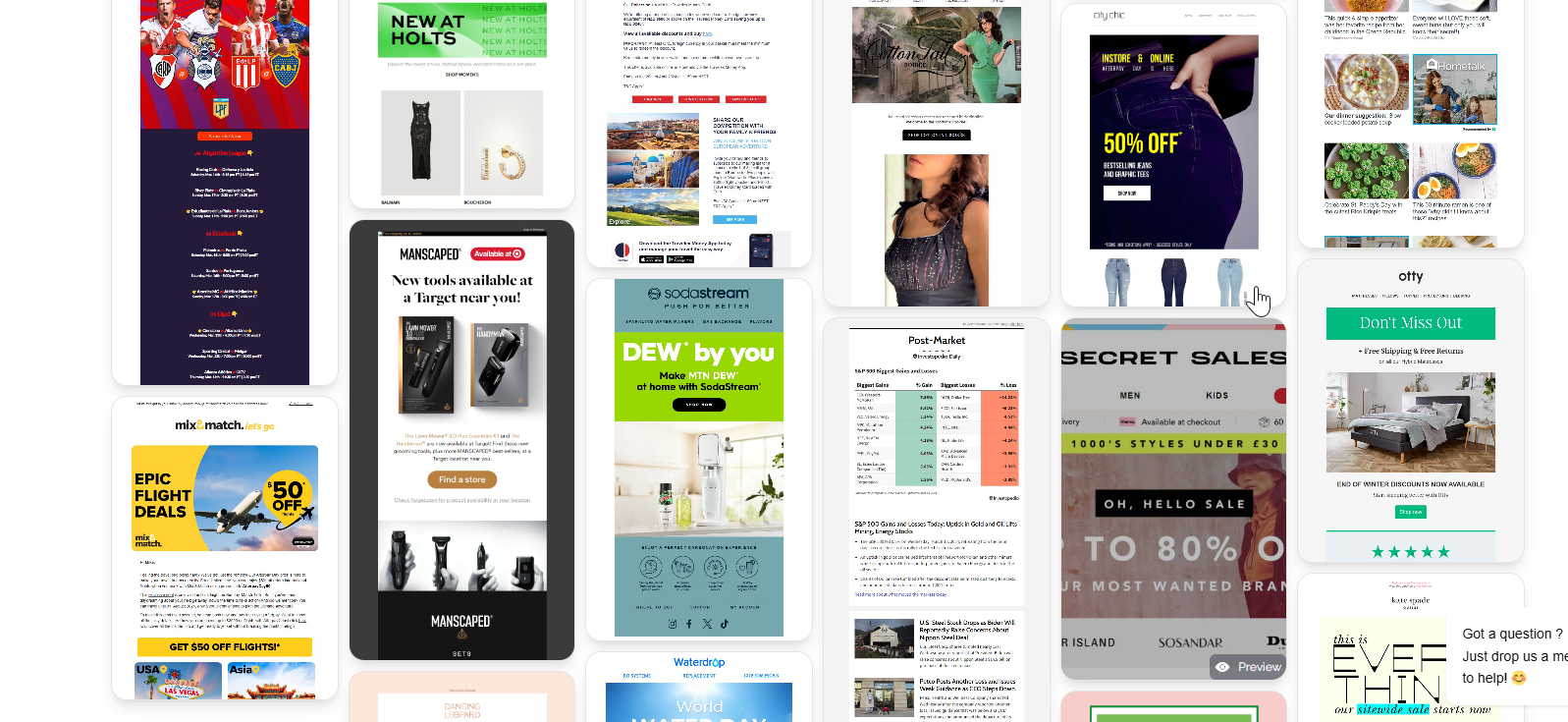
Before designing your emails, look at what top brands actually send. MailGlider's template library has thousands of real email examples organized by brand, campaign type, and industry — the fastest way to understand what high-performing emails look like across categories.
Step 6: Measure and Iterate
After every campaign, check:
- Open rate (benchmark: 20–40%)
- Click rate (benchmark: 2–5%)
- Unsubscribes (warning: >0.5% per send)
- Revenue / conversions attributed
Email Marketing Best Practices for 2025
- Write like a person, not a brand. Emails that sound human outperform polished corporate copy.
- Mobile-first always. 60%+ of opens happen on phones. If it breaks on mobile, it fails.
- One CTA per email. Multiple links dilute attention. Pick one action and make it unmissable.
- Authenticate your domain. SPF + DKIM + DMARC = inbox placement. Skip it and you'll hit spam.
- Clean your list quarterly. Sending to dead addresses tanks your deliverability scores.
- Don't obsess over open rates alone. Apple's Mail Privacy Protection inflates opens. Track clicks and conversions instead.
Frequently Asked Questions
Is email marketing still worth it in 2025?
Yes — it's the highest-ROI marketing channel available. With 4.6 billion email users globally and an average return of $36 per $1 spent, email outperforms every alternative on direct revenue attribution.
What's the difference between email marketing and spam?
Permission. Spam is unsolicited. Email marketing only goes to people who explicitly opted in, at an address they provided, with a clear way to unsubscribe at any time. Spam violates this; email marketing respects it.
How do I grow an email list fast?
Lead magnets work best — offer something genuinely useful in exchange for a signup (template, guide, checklist, mini-course). Embed the opt-in form where attention already exists: top of blog posts, homepage, social bio.
How often should I email my list?
Weekly is a solid default for most businesses. For newsletters, bi-weekly works well. The rule: be consistent enough that subscribers don't forget you, but not so frequent you become noise.
What's a good open rate for email marketing?
20–40% is the general benchmark, but this varies by industry. B2B can see 25–35%. E-commerce averages 15–25%. Note: since Apple's Mail Privacy Protection, open rates can be artificially inflated — use click rate as a more reliable signal.
Conclusion
Email marketing is not complicated — but it does require consistency, permission, and a real commitment to providing value. Start with a small, properly-built list. Send something useful on a predictable schedule. Measure clicks and conversions, not vanity metrics. Iterate.
If you want to see what great email looks like before you write your own, browse MailGlider — a curated library of real emails from top brands, organized by type, industry, and campaign goal. Understanding what works is the fastest shortcut to building your own high-performing email strategy.