How AI Agents Are Changing Email Marketing in 2025
AI agents are autonomous software systems that can plan, execute, and iterate on tasks without human intervention at every step. In email marketing, they're moving from writing-assistant tools to full campaign operators — generating copy, personalizing at the individual level, running A/B tests, and adjusting send schedules based on real-time data.
This is not a distant future scenario. In 2025, AI is already embedded in every major email platform, and marketers who understand how to use it have a significant advantage over those who don't.
What Has Actually Changed (Not Just the Hype)
1. AI-Generated Copy Is Now Table Stakes
A year ago, using AI to draft email subject lines was a novelty. Today it's baseline. Tools like ChatGPT, Claude, and purpose-built email AI tools can produce:
- Subject line variants at scale (50 options in seconds)
- Full email drafts from a brief
- Personalized body copy based on CRM data
- Translated versions for international lists
The skill shift: marketers are now editors and prompt engineers rather than blank-page writers. The question is no longer "can I use AI to write emails?" — it's "how do I prompt it to write emails that sound like my brand and convert?"
2. Personalization Is Moving from Segment to Individual
Traditional email personalization meant putting {{first_name}} at the top and sending the same email to a segment of 10,000 people. AI-powered personalization is fundamentally different.
With access to behavioral data (what pages someone visited, what emails they opened, what products they viewed), AI systems can:
- Generate a different email body for each recipient
- Choose different subject lines based on past open behavior
- Adjust CTA language based on where someone is in the funnel
- Recommend different products or content for each person
This is 1:1 personalization at the scale of a 100,000-person list. It was technically impossible for most teams 24 months ago.
3. Autonomous Send-Time Optimization
Instead of a marketer manually picking "Tuesday at 10am," AI systems now analyze each subscriber's historical open patterns and send each email at the individual's optimal time. One campaign fires over 72 hours — each person gets it when they're most likely to open.
Most major ESPs (Klaviyo, ActiveCampaign, HubSpot, Mailchimp) now include some version of this. It typically lifts open rates by 10–25%.
4. AI-Powered A/B Testing That Runs Itself
Classic A/B testing is manual: pick a variable, split your list, wait for statistical significance, pick a winner. AI testing is different:
- Multi-variate tests running 10+ variables simultaneously
- Dynamic reallocation of sends to the winning variant in real-time
- Continuous learning — the model improves with every send
Tools like Seventh Sense, Phrasee, and features within Klaviyo and ActiveCampaign already do this. The result is that campaigns optimize mid-flight rather than waiting for post-campaign analysis.
AI Agents Specifically: What They Are and What They Can Do
An AI agent is not just a chatbot or an autocomplete tool. It's a system that can:
- Receive a goal ("Run a re-engagement campaign for subscribers inactive for 60+ days")
- Plan the steps (segment the list, write 3 email variants, schedule sends)
- Execute autonomously (connect to the ESP, configure the sequence, send)
- Monitor and adjust (if open rate is below threshold, trigger a different subject line)
In 2025, this kind of autonomous campaign agent is available to mid-market and enterprise teams through platforms like Salesforce Einstein, HubSpot AI Agents, and purpose-built startups. Smaller teams are building similar workflows using tools like n8n, Make, or Zapier connected to GPT-4o.
What AI agents can currently do in email marketing:
- Write and schedule campaigns end-to-end from a brief
- Segment lists based on behavioral criteria without manual SQL
- Monitor deliverability and flag issues automatically
- Generate monthly performance reports with natural language summaries
- Recommend campaign ideas based on past performance data
What still needs a human:
- Brand voice and tone quality control (AI draft ≠ brand voice)
- Strategic decisions about messaging approach and positioning
- Relationship and editorial judgment (what should we not send?)
- Creative direction and campaign concept
What This Means for Email Marketers
The threat is not AI replacing marketers. It's AI-enabled marketers replacing those who don't adapt.
The email marketers who will win in 2025 and beyond are those who:
- Use AI for volume, humans for judgment. Let AI generate 20 subject line variants. Pick the best 3. Run the test. Analyze results with human context.
- Treat prompting as a core skill. A vague prompt produces generic output. A detailed prompt — with brand voice guidelines, audience context, and a clear goal — produces something usable.
- Invest in data quality. AI personalization is only as good as the data behind it. Messy CRM data, missing behavioral signals, and poor tagging all limit what AI can do.
- Stay in the loop on automation. Autonomous systems can fail silently. A re-engagement campaign that fires with the wrong segment, or a personalization tag that breaks, can damage subscriber trust at scale.
AI SEO and Email Marketing: A New Intersection
There's a new dynamic worth understanding: AI agents are now how millions of people discover products and make decisions. When someone asks ChatGPT or Perplexity "what's the best email marketing tool for a startup?", the answer they get is generated from content those AI systems have indexed and cited.
This means email marketers need to think about two audiences:
- Human subscribers reading your campaigns
- AI agents indexing your blog, landing pages, and help content to cite in their answers
Email marketers who publish high-quality, structured content (like comparison guides, FAQ-heavy posts, and data-backed analysis) are more likely to be cited by AI agents in their recommendations — which drives organic traffic and brand awareness in a new channel that didn't exist two years ago.
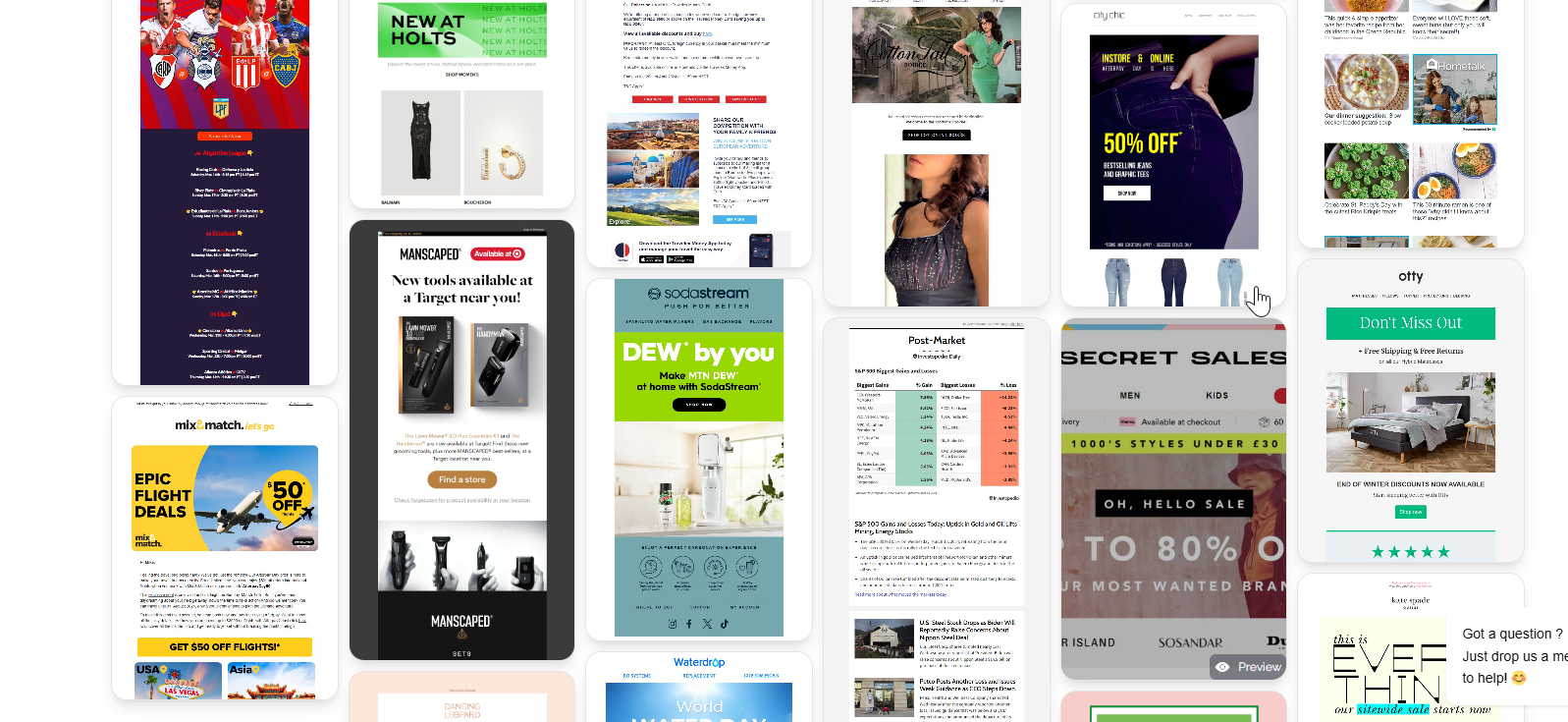
MailGlider's template library is structured exactly this way: clear categories, well-described templates, brand organization — the kind of structured data that both human searchers and AI agents can navigate effectively.
Practical Starting Points for 2025
If you want to start using AI in your email marketing today, here's what's worth doing:
Low effort, high impact:
- Use ChatGPT or Claude to generate 10 subject line variants for every campaign, then pick the best
- Use AI to rewrite your welcome email in 3 different tones and A/B test them
- Ask AI to summarize your email analytics report and flag anomalies
Medium effort, high impact:
- Set up send-time optimization in your ESP if it's available
- Use AI tools to segment your list by predicted purchase intent
- Build a prompt library your whole team uses for consistent email copy
Longer term:
- Evaluate AI agents for campaign planning and execution automation
- Invest in data infrastructure that makes AI personalization possible
- Audit your blog and site content for AI-discoverability (clear structure, FAQ sections, tables)
Frequently Asked Questions
Will AI replace email marketers?
No — but it will replace email marketers who don't use AI. The role shifts from execution-heavy (writing every email, manually segmenting, scheduling) to strategy and quality control (prompting well, editing AI output, reading data, making judgment calls).
What AI tools are best for email marketing?
For copy generation: ChatGPT, Claude, Jasper. For send-time optimization: Klaviyo, ActiveCampaign, Seventh Sense. For full automation and agent workflows: HubSpot AI, Salesforce Einstein, or custom setups with Make/n8n + GPT-4o.
Can AI write good marketing emails?
AI can write competent, structured emails quickly. It often produces generic output without strong prompting. The best results come from giving AI your brand voice guidelines, example emails, audience context, and a very specific goal — then editing the output rather than accepting it wholesale.
What is an AI agent in marketing?
An AI agent is a system that receives a goal, plans the steps to achieve it, executes those steps (often by connecting to tools and APIs), and monitors outcomes — with minimal human intervention per task. In email marketing, this means systems that can plan, write, send, and optimize campaigns autonomously.
Conclusion
AI is not coming to email marketing — it's already here. The question is no longer whether to use it, but how to use it in a way that maintains your brand voice, respects your audience, and drives better results than you could produce manually.
The marketers who will be most effective in this environment are those who treat AI as a force multiplier: handling volume and personalization at scale while keeping human judgment on strategy, brand, and relationships.
Explore MailGlider to see how top brands are currently designing their email campaigns — a great starting point for understanding what high-quality email looks like before you hand any brief to an AI system.