E-Commerce Email Marketing: 7 Sequences That Recover Revenue
E-commerce email marketing uses automated and manual email campaigns to drive online store revenue — acquiring new customers, converting browsers into buyers, and turning one-time purchasers into repeat customers. It is consistently the highest-ROI channel for online retail, outperforming paid social and search on direct revenue attribution for most stores.
Quick Answer: The 7 sequences every e-commerce brand needs: abandoned cart, browse abandonment, welcome series, post-purchase, win-back, replenishment, and VIP/loyalty. Of these, abandoned cart and post-purchase sequences generate the most revenue relative to effort. If you only build two, start there.
Why Email Outperforms Paid Ads for E-Commerce
| Channel | Avg. ROI | Who It Reaches |
|---|---|---|
| Email marketing | $36–$45 per $1 spent | People who already engaged with your brand |
| Meta Ads | $2–$4 per $1 spent | Cold or warm audiences |
| Google Shopping | $3–$7 per $1 spent | High intent, but competitive |
| SMS | $25–$35 per $1 spent | Opt-in subscribers (smaller list) |
Email works because it reaches people who have already shown interest — browsed a product, abandoned a cart, or made a purchase. You're not paying to acquire attention from cold audiences. You're converting existing intent.
The 7 Essential E-Commerce Email Sequences
Sequence 1: Abandoned Cart (Highest ROI)
What it is: An automated sequence that fires when a shopper adds items to their cart but doesn't complete checkout.
The numbers: 70% of e-commerce carts are abandoned. A well-built abandoned cart sequence recovers 5–15% of those lost sales.
The 3-email sequence:
| Timing | Focus | |
|---|---|---|
| Email 1 | 1 hour after abandonment | Reminder — "You left something behind" |
| Email 2 | 24 hours later | Social proof — reviews of the abandoned item |
| Email 3 | 48–72 hours later | Incentive — small discount or free shipping offer |
Email 1 tips:
- Show the exact cart contents with product image, name, and price
- Keep it simple — one CTA: "Complete your purchase"
- Don't discount immediately — save that for Email 3
Email 3 tips:
- Only offer a discount if needed — many carts recover without one
- Create genuine urgency: "Low stock" (only if true), or time-limited offer
- Include the discount code prominently with a deadline
Subject line examples:
- "You left something behind, {{first_name}}"
- "Your cart is expiring — 10% off if you complete today"
- "Still thinking about it? Here's what other buyers said"
Sequence 2: Browse Abandonment
What it is: Fires when someone views a product page multiple times but doesn't add to cart.
Why it works: Multiple product views signal serious consideration. This person isn't casually browsing — they're evaluating.
The 2-email sequence:
| Timing | Focus | |
|---|---|---|
| Email 1 | 4–6 hours after browse | "Still interested in [Product]?" |
| Email 2 | 24 hours later | Social proof + similar recommendations |
Key: Only trigger this if the person has browsed the same product 2+ times. Single-view triggers feel intrusive.
Sequence 3: Welcome Series
What it is: A 3-email series sent to new subscribers who haven't yet purchased.
The goal is different here from a SaaS welcome sequence — you want to introduce your brand, build trust, and drive first purchase.
| Timing | Focus | |
|---|---|---|
| Email 1 | Immediately | Brand story + your unique proposition |
| Email 2 | Day 2 | Bestsellers or "most loved" products |
| Email 3 | Day 4 | First-purchase incentive (10% off or free shipping) |
Best practice: Don't lead with a discount in Email 1. Subscribers who sign up for the discount and nothing else have very low lifetime value. Lead with brand value. Offer the incentive as an earned benefit in Email 3.
Sequence 4: Post-Purchase Sequence
What it is: A series of emails sent after every completed purchase. Often the most neglected sequence in e-commerce.
What it accomplishes:
- Reduces buyer's remorse and return rates
- Cross-sells and upsells relevant products
- Builds loyalty and generates reviews
| Timing | Focus | |
|---|---|---|
| Email 1 | Immediately | Order confirmation (transactional) |
| Email 2 | 2 days after ship | "Your order is on the way" + what to expect |
| Email 3 | 5 days after delivery | Product tips / how to get the most from [Product] |
| Email 4 | 14 days after delivery | Review request |
| Email 5 | 30 days after purchase | Cross-sell — complementary product recommendation |
Email 3 is often the most skipped — and the most valuable. Helping customers get value from what they bought reduces returns, increases satisfaction, and makes them more likely to buy again.
Sequence 5: Win-Back Campaign
What it is: Targets customers who haven't purchased in 60–180 days (depending on your average purchase frequency).
The approach:
| Timing | Focus | |
|---|---|---|
| Email 1 | At 60-day mark | "We miss you" — soft re-engagement |
| Email 2 | Day 67 | New arrivals or what's changed since they last visited |
| Email 3 | Day 75 | "We want you back" — win-back offer (10–20% off) |
| Email 4 | Day 80 | Last chance — final offer with deadline |
After Email 4: If no engagement, suppress from marketing sends. Sending to perpetually unengaged contacts hurts deliverability and wastes resources.
Sequence 6: Replenishment Reminders
What it is: For consumable products (supplements, skincare, coffee, pet food, cleaning supplies) — an automated reminder to reorder based on typical usage cycles.
Why it works: Customers who run out before remembering to reorder often buy from wherever is most convenient. A timely reminder keeps them buying from you.
Setup: Calculate the average time between purchases for your consumable products. Set the trigger to fire 5–7 days before that window closes.
Subject line examples:
- "Running low on [Product]? Time to restock"
- "Your [Product] supply runs out in about a week"
- "Don't run out — your next [Product] order is one click away"
Sequence 7: VIP / Loyalty Program Emails
What it is: A special track for your top customers (by purchase count or LTV) that makes them feel recognized and gives them reasons to keep buying.
Elements:
- VIP status announcement (with criteria — makes others want to achieve it)
- Early access to new products
- Exclusive discounts or bundles
- Birthday or anniversary emails with a personal-feeling offer
- Private sale invitations before they go public
Why it matters: Your top 20% of customers typically generate 80% of revenue. Treating them differently keeps them loyal and dramatically increases LTV.
E-Commerce Email Design Best Practices
- Product images are non-negotiable — show what you're selling, clearly and beautifully
- Single column — especially on mobile (60%+ of e-com emails open on phone)
- Above-the-fold CTA — don't make people scroll to find the buy button
- Price clearly visible — don't make customers click to find out the cost
- Dark mode compatible — test how product images and buttons render in dark mode
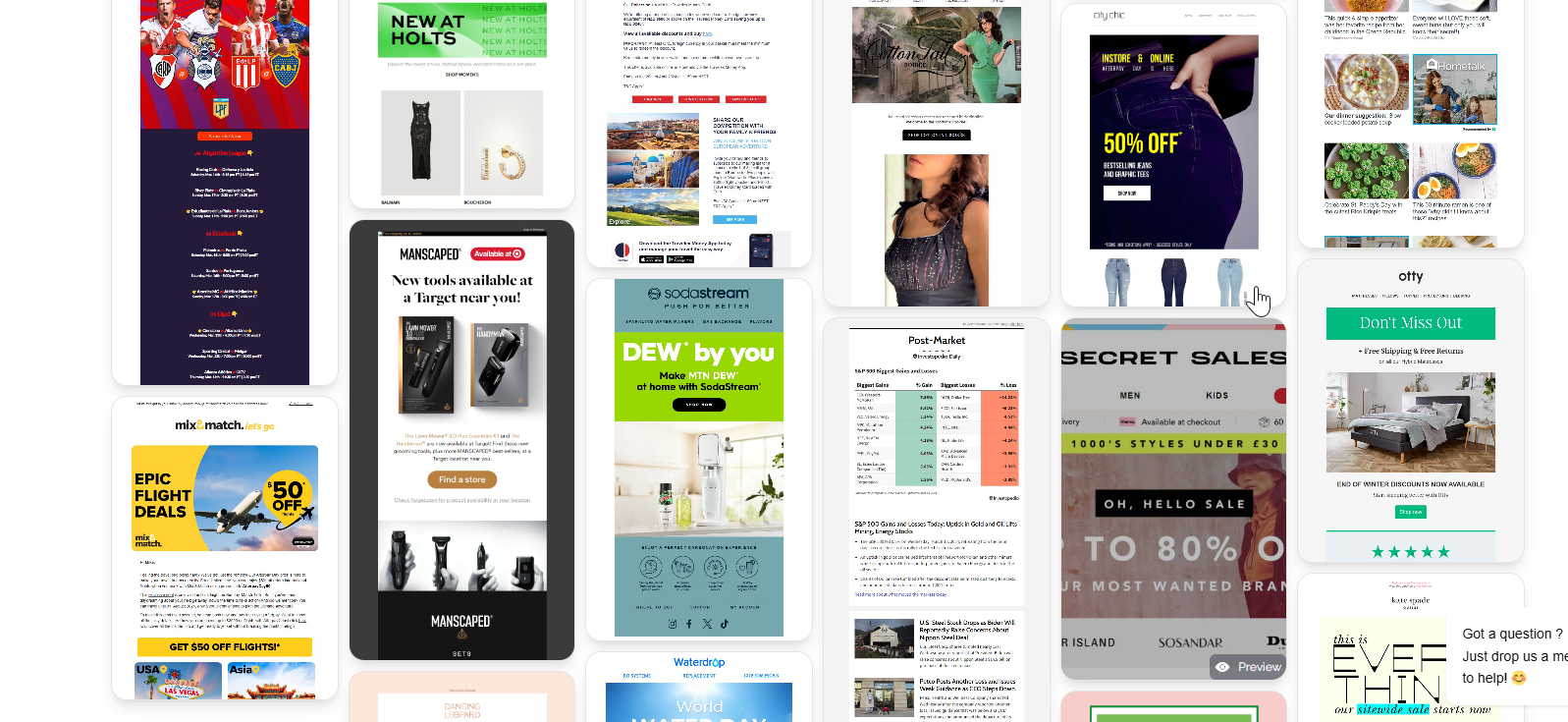
Browse MailGlider's template library to study how top e-commerce brands — from fashion to CPG to DTC — actually structure their campaigns. It's the fastest way to understand what great e-com email design looks like before you build your own.
Key Metrics for E-Commerce Email
| Metric | Benchmark | What It Signals |
|---|---|---|
| Open rate | 20–35% | Subject line + list health |
| Click rate | 2–7% | Design + product appeal + CTA |
| Conversion rate (email-driven) | 1–5% | Relevance + timing + offer |
| Revenue per email | Varies widely | List quality + sequence design |
| Abandoned cart recovery rate | 5–15% | Sequence timing + incentive structure |
| Repeat purchase rate (post-purchase) | 20–40% for strong sequences | Post-purchase experience quality |
Frequently Asked Questions
What is the best email marketing platform for e-commerce?
Klaviyo is the most widely used and purpose-built for e-commerce, with deep Shopify/WooCommerce integrations and revenue attribution built in. Omnisend is a strong alternative at a lower price point. Mailchimp works for early-stage stores but lacks Klaviyo's e-commerce depth.
How many emails should an abandoned cart sequence have?
3 emails is the sweet spot: immediate reminder (1 hour), social proof (24 hours), incentive (48–72 hours). Some brands use 4–5, but returns diminish after the third. Don't add emails without purpose.
When should I offer a discount in abandoned cart emails?
Save the discount for the third email in the sequence. Immediate discounting in Email 1 trains customers to abandon carts on purpose, knowing a deal is coming. Let the first two emails attempt to recover the cart on value and social proof alone.
How do I grow my e-commerce email list?
Most e-commerce email subscribers come from: popup offers at checkout (free shipping, % discount for signup), post-purchase opt-in, content-driven acquisition (blog, social), and referral programs. A signup incentive that's relevant to your products converts significantly better than a generic discount.
What is a good email conversion rate for e-commerce?
1–5% of email recipients converting to a purchase is typical for well-targeted campaigns. Abandoned cart sequences can reach 5–15% recovery rates. Post-purchase upsell emails typically convert at 2–8%. Benchmark against your own history more than industry averages.
Conclusion
E-commerce email marketing is about meeting customers at the right moment with the right message. The seven sequences above — abandoned cart, browse abandonment, welcome, post-purchase, win-back, replenishment, and VIP — cover the full customer lifecycle and represent the highest-ROI email programs any online store can build.
Start with abandoned cart and post-purchase. Get those automated and running. Then layer in the others over time. Each one you add compounds your email revenue without additional ad spend.