The Best Email Marketing Tools in 2025 (Compared & Ranked)
The best email marketing tool in 2025 depends on your use case — there is no single winner. A solo creator building a newsletter needs something completely different from a SaaS team running lifecycle automation or an e-commerce brand managing cart abandonment flows. This guide breaks down the top platforms by category so you can pick the right one without wasting months on the wrong trial.
Quick Answer: For beginners → Mailchimp or Beehiiv. For creators/newsletters → ConvertKit. For SaaS → Loops or Customer.io. For e-commerce → Klaviyo. For advanced B2B automation → ActiveCampaign or HubSpot.
What to Look for in an Email Marketing Tool
Before comparing platforms, know what actually matters for your situation:
| Factor | Why It Matters |
|---|---|
| List size pricing | Most tools charge per subscriber — costs scale dramatically |
| Automation depth | Basic drip vs. complex behavioral branching |
| Deliverability | Shared vs. dedicated IPs, domain authentication support |
| Integrations | Shopify, Stripe, Webflow, your CRM |
| Template library | Quality and quantity of starting points |
| Reporting | Open/click tracking, revenue attribution, A/B test results |
The Best Email Marketing Tools in 2025
1. Mailchimp — Best for Beginners
What it is: The most widely used email marketing platform globally. Solid all-rounder with a strong free tier.
Best for: Businesses just starting out, small teams, anyone who needs to move fast without a learning curve.
Pros:
- Generous free tier (up to 500 contacts, 1,000 emails/month)
- Strong template library with drag-and-drop editor
- Built-in landing page builder and signup forms
- Excellent documentation and onboarding
Cons:
- Gets expensive quickly as your list grows
- Automation features are limited compared to competitors at the same price
- Removed free automation in 2019 — basic drips now require a paid plan
Pricing: Free (500 contacts) → $13/mo (Essentials) → $20/mo (Standard) → $350/mo+ (Premium)
Bottom line: The safest starting point. Outgrow it by ~2,000 contacts and you'll want to migrate.
2. Klaviyo — Best for E-Commerce
What it is: The go-to platform for Shopify and DTC brands. Built from the ground up around revenue attribution and behavioral triggers.
Best for: E-commerce brands that need abandoned cart flows, post-purchase sequences, and product recommendation emails.
Pros:
- Deep Shopify/WooCommerce/BigCommerce integrations
- Powerful segmentation based on purchase behavior
- Revenue attribution built into every report
- SMS and email in one platform
Cons:
- Expensive — pricing scales steeply with list size
- Overkill for businesses that don't sell products
- Steeper learning curve than Mailchimp
Pricing: Free (up to 250 contacts) → scales with list size; 10,000 contacts ≈ $150/mo
Bottom line: If you're on Shopify and serious about email revenue, Klaviyo is the standard. Non-e-commerce businesses should look elsewhere.
3. ConvertKit (now Kit) — Best for Creators
What it is: Built specifically for creators, bloggers, podcasters, and course builders. Very clean interface, strong landing page tools.
Best for: Individual creators monetizing an audience — selling courses, memberships, or digital products.
Pros:
- Visual automation builder that's actually easy to use
- Creator-native features (commerce, tip jar, paid newsletters)
- Clean, minimal email editor (forces good email design habits)
- Strong community and creator ecosystem
Cons:
- Limited design flexibility (intentionally minimal)
- Less powerful for e-commerce or complex B2B workflows
- Reporting is basic compared to Klaviyo or ActiveCampaign
Pricing: Free (up to 1,000 subscribers) → $25/mo (Creator) → $50/mo (Creator Pro)
Bottom line: The best choice for solo creators and newsletter operators. Not a fit for product companies or complex teams.
4. ActiveCampaign — Best for Advanced Automation
What it is: The most powerful automation platform in this tier. Used by SMBs and mid-market companies that need complex, branching workflows.
Best for: Teams that need deep CRM integration, lead scoring, conditional automation logic, and multi-step customer journeys.
Pros:
- Best-in-class visual automation builder
- Built-in CRM + sales pipeline
- Advanced segmentation and conditional logic
- Strong deliverability
Cons:
- Steep learning curve — takes time to master
- Interface feels dated in places
- Expensive relative to simpler tools
Pricing: $15/mo (Lite, 1,000 contacts) → scales significantly; 10,000 contacts ≈ $139/mo
Bottom line: The right choice when you've outgrown simpler tools and need automation that can handle real business complexity.
5. Beehiiv — Best for Newsletter Operators
What it is: A newsletter-native platform built by former Morning Brew team members. Designed specifically for building and monetizing newsletters.
Best for: Operators building a newsletter as a primary product — with subscriptions, ads, or referral programs.
Pros:
- Built-in paid subscription and monetization tools
- Referral program native to the platform
- Clean reading experience and great web presence
- Very generous free tier (2,500 subscribers)
- Ad network for newsletter monetization
Cons:
- Not a fit for e-commerce or SaaS lifecycle email
- Automation capabilities are basic
- Limited design customization
Pricing: Free (up to 2,500 subscribers) → $42/mo (Scale) → $84/mo (Max)
Bottom line: The best platform if your business is the newsletter. Not designed for product teams or e-commerce.
6. Loops — Best for SaaS
What it is: A modern email automation platform built specifically for SaaS products. Integrates with your app via API to send event-triggered lifecycle emails.
Best for: SaaS teams that want to connect email sends directly to product events (signed up, activated feature, hit usage limit, churned).
Pros:
- Clean, modern interface designed for product teams
- Loops-native events connect directly to your app
- Transactional + marketing email in one platform
- Strong Stripe, Segment, and Zapier integrations
Cons:
- Younger platform — fewer templates and less documentation
- Less powerful reporting than Klaviyo or ActiveCampaign
- Not designed for e-commerce
Pricing: Free (up to 1,000 contacts) → $49/mo → scales with contacts
Bottom line: The most modern SaaS-native option. If you're building a product and want email wired directly to user actions, Loops is worth serious consideration.
7. Customer.io — Best for Product-Led Growth
What it is: A developer-friendly, data-warehouse-native email platform. Used by product-led growth companies to send highly personalized lifecycle emails at scale.
Best for: Tech-forward SaaS and product teams with engineering resources, who want to build email logic around complex data.
Pros:
- Extremely flexible data model — send any attribute or event
- Multi-channel (email + SMS + push + in-app)
- Excellent segmentation and behavioral targeting
- Strong API and webhook support
Cons:
- Requires technical setup — not a marketer-self-serve tool
- Expensive for smaller teams
- Overkill for simple use cases
Pricing: $100/mo base → scales with message volume
Bottom line: The power tool for product-led SaaS teams with engineering support. The best choice when your email logic is driven by complex product data.
Comparison at a Glance
| Tool | Best For | Free Tier | Starting Price |
|---|---|---|---|
| Mailchimp | Beginners | ✅ 500 contacts | $13/mo |
| Klaviyo | E-commerce | ✅ 250 contacts | ~$30/mo |
| ConvertKit | Creators | ✅ 1,000 contacts | $25/mo |
| ActiveCampaign | Advanced automation | ❌ | $15/mo |
| Beehiiv | Newsletters | ✅ 2,500 contacts | $42/mo |
| Loops | SaaS | ✅ 1,000 contacts | $49/mo |
| Customer.io | Product-led teams | ❌ | $100/mo |
One Tool They All Need: A Template Library
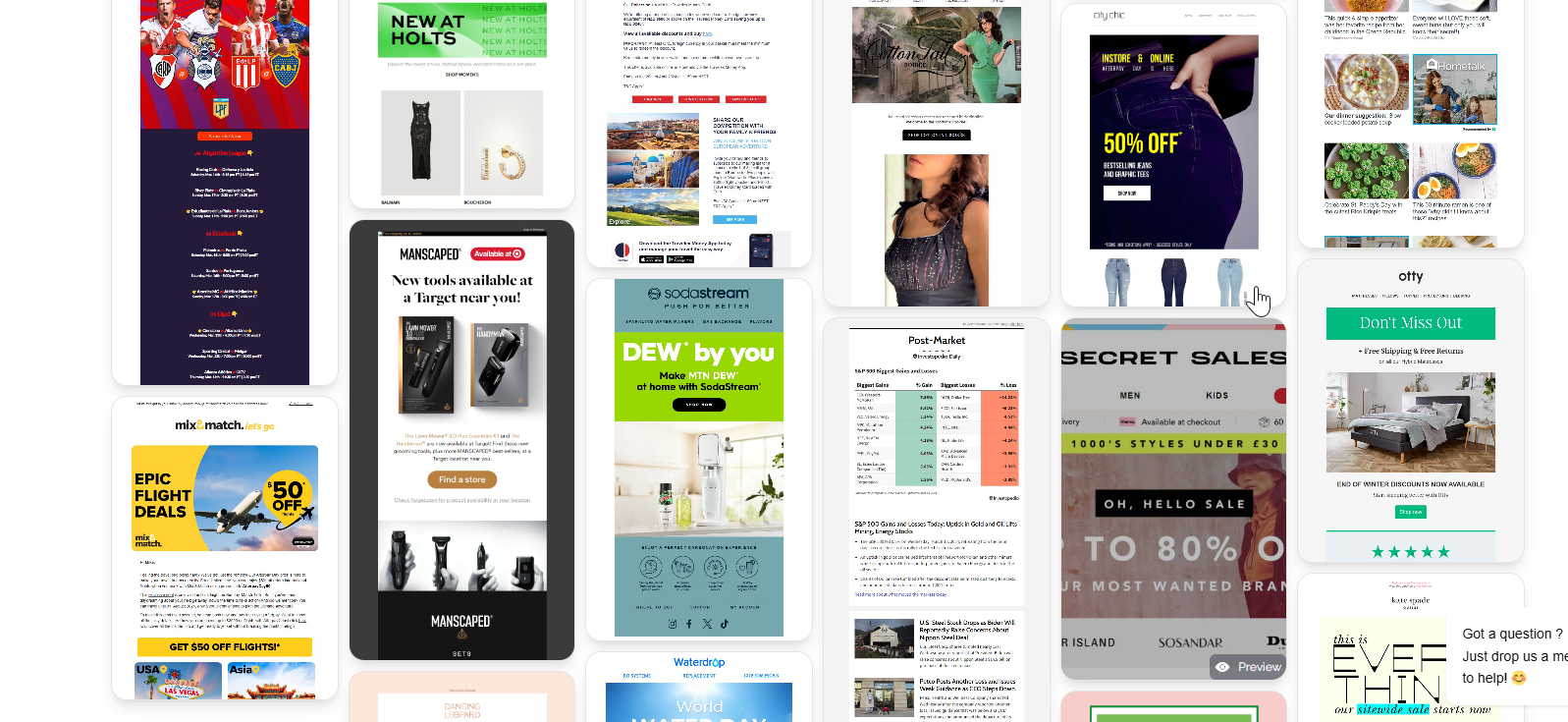
Regardless of which ESP you use, you need to know what great email looks like before you design your own. MailGlider is a curated library of real email templates from hundreds of top brands, organized by campaign type and industry — the fastest way to understand what's working across categories before you build in your platform of choice.
Frequently Asked Questions
What is the best free email marketing tool?
Beehiiv (2,500 contacts free) and ConvertKit (1,000 contacts free) offer the most generous free tiers. Mailchimp's free plan is more limited but covers basics. For e-commerce, Klaviyo's 250-contact free tier lets you test the platform before committing.
What is the easiest email marketing tool for beginners?
Mailchimp is the easiest to get started with — the drag-and-drop editor, templates, and onboarding are well-designed for non-technical users. Beehiiv is also very beginner-friendly if your primary use case is a newsletter.
Which email platform has the best automation?
ActiveCampaign has the most powerful visual automation builder for marketing automation. Customer.io and Loops are more powerful for event-driven product automation. Klaviyo leads for e-commerce behavioral automation.
Can I switch email platforms without losing my list?
Yes. You can export your list as a CSV from most platforms and import it into a new one. The main risk is deliverability during transition — warm up the new platform gradually rather than immediately sending to your full list.
Do I need a paid email marketing tool?
Not immediately. Start with the free tier of whichever platform fits your use case. Upgrade when you hit the contact limit or need features (advanced automation, A/B testing) that require a paid plan.