Good morning? Starbucks locations in China are marking the Lunar New Year with the “Abundant Year Savory Latte,” a drink mixing espresso and steamed milk with… pork flavor sauce. There’s also more pork sauce drizzled on top, with a skewered pork slice served as garnish. The latte has been described as “unique” and “interesting,” which is always the most polite way to say something’s so, so bad.
In today’s email:
Biometric tech: Taking over an airport near you.
Taking its licks: The fall ofchocolate chip ice cream.
Why, though?: A novel (but not cool enough) sunglasses idea.
Around the web: Red Bull’s $16B marketing strategy, testing new keyboards, Gmail hacks, and more.
👇 Listen: Facial recognition tech stands to replace travelers’ humble passports. Is that a good thing?
The Big Idea
Biometric tech is taking off in airports
Biometric tech is going global, one airport at a time.
2024-02-21T00:00:00Z
Sara Friedman
It’s not a trip to the airport if you don’t check for your passport at least a dozen times on the ride over.
But what if you could rid yourself of that anxiety — and of your passport altogether?
While the TSA has used facial recognition tech since 2019, the “tipping point” for air travel biometrics could come in 2024, perThe New York Times.
Experimental programs are already underway in airports around the country:
Delta Digital ID allows PreCheck members to scan their faces instead of boarding passes and IDs at five US airports.
United Airlines lets PreCheck travelers use their faces to check bags at select airports.
American Airlines flyers can get into the airline’s Dallas airport lounge with just their faces.
With TSA facial screening verification already used at ~30 airports and expanding to 400+ more in the coming years, biometric tech looks like it’s here to stay.
Future of flying
One report suggests that 70% of global airlines will use biometric tools for identification by 2026, with 90% of airports already investing in the tech.
Facial recognition technology could grow smart enough for us to ditch physical identification entirely, allowing travelers to go door to door with just their mugs.
This could save a lot of time: Facial scanning cuts over a minute from the bag drop process (down to 30 seconds) and 15 seconds off security interactions (to ~10 seconds).
Overseas, biometric tech is already far ahead:
Singapore’s Changi Airport is going passport-free for all departures.
Germany’s Frankfurt Airport lets passengers use their faces for the entire travel process.
In China, 86% of the country’s international airports use biometric tech. Beijing Capital International Airport lets travelers use their faces at every step of their trip, including checking out at duty-free stores.
But back in the US…
… only ~36% of international airports employ biometric tech. Most of the updates are due to a 2001 congressional mandate requiring airports to add systems that allow for biometric identification of all travelers coming in or out of the US.
That rollout is finished for US entries — it scanned ~113m of them last year — and will be available for all departures by 2026.
Of course, the tech is not without its downsides: there are concerns about its ramifications for privacy and surveillance.
Free Resource
Pro tips for nailing your sales calls
The best never stumble into sales calls with a plan that’s only 70% there. That would mean losing out on leads, and probably offsetting many of the gold stars you’ve gathered from the boss.
Those are your gold stars. Read the sales pitch playbook we wrote with our pals at PandaDoc to hone how you close on the phone.
Good to know: Apple finally weighed in on the age-old question of whether rice can save your iPhone after it goes for a swim. In a support document, the company said grains of rice could actually damage your phone further (it also nixed cotton swabs and external heat sources).
SNIPPETS
Capital Oneclosed a $35.3B deal to acquire Discover Financial Services. If approved by antitrust regulators (a huge “if”), the merger would create the US’s largest credit card company.
Speaking of acquisitions: Walmart is buying TV brand Vizio for $2.3B. Walmart, which already carried Vizio products, plans to use the merger to boost its advertising business.
Saudi Arabia’s sovereign wealth fund is low on cash, relatively speaking. It ended 2023 with ~$15B on hand, a big dip from 2022’s $50.4B cash pool, and the kingdom is planning to sell stock in its oil giant Saudi Aramco to fund bonkers projects like Neom.
Coca-Cola revealed its 10th Creations drink: Coca-Cola K-Wave Zero Sugar, a fruity soda meant to elicit the excitement one feels when first becoming a fan of K-pop music.
Oof: A Washington DC man is suing the Powerball lottery after administrators claimed his $340m jackpot was a mistake. A contractor said the man’s ticket matched the test numbers it posted to the game’s website during an update — not the real numbers.
Huh: Florida investigators allege three people used a barcode swapping scheme at self-checkout stations to steal 281 buckets of roof sealer — worth $100k+ — from Home Depot stores.
Don't miss this...
Want to enjoy beastly (financial) gains? Check out two fur-rocious fitness trends you can pounce on for wild profits in this week’s Trends newsletter.
Data Point
Falling out of flavor: Chocolate chip ice cream sales have frozen over. The once-classic flavor slid out of America’s top 10 bestselling list, according to the International Dairy Foods Association, and sales have dipped 22% in volume from 2018 to 2022. Vanilla ice cream is also in trouble, falling 6.4% over the same window. But America may have found its new dessert darling: cookies-and-cream sales are up a whopping 72.6%.
Don't miss this...
There are thousands of companies valued at $1B+. How many clues do you need to identify today’s billion-dollar brand?
Clue 1: Well, they’ve definitely got the “mutual” part of mutual fund down pat —this company boasts ~50m customers, which probably includes you if you’ve worked for a few American companies.
Clue 2: Desperate for Baby Boomers’ approval, it has employed Paul McCartney and comedians Lily Tomlin and Don Rickles as spokespeople. Why the desperation? Boomers control ~70% of investable assets.
Clue 3: Its CEO has ranked in the top 10 of Forbes’ annual World’s 100 Most Powerful Women list every year since 2017. She also has a second Forbes honorific: richest person in Massachusetts.
👇 Scroll to the bottom for the answer 👇
Failure to launch
Why, though? Sunglasses with sound, but no style
Oakley tried to combine sunglasses with an MP3 player, but it just wasn’t cool or cheap enough.
2024-02-21T00:00:00Z
Juliet Bennett Rylah
The jury’s still out on the success of Apple’s Vision Pro, but VR headsets are meant to be immersive, so it makes sense for them to cover both a user’s eyes and ears.
But 2004’s Oakley Thump — sunglasses, earbuds, and an MP3 player all in one — was just too expensive for what it provided.
Sunglasses…
… are for protecting your eyes from the sun and looking cool. Oakley Thump came in a single style and a handful of colors, none of which made anyone look cool — not even Lil Jon, who had his own edition.
Attached were a pair of earbuds and a rechargeable MP3 player, which could hold up to 128MB or 256MBs of music. The 256MB version cost $495 ($800+ today), perEngadget.
What went wrong?
Back when most people used wired headphones, a device with six hours of battery life that wouldn’t tangle you in wires may have been appealing, especially for joggers or bikers.
Engadget found the Thump easy to use and the sound quality “surprisingly excellent.”
However, there are only so many activities one performs in sunglasses, unless they’re a Terminator.
The much cheaper iPod Shuffle (RIP) and other competitors retailed for several hundreds less, and didn’t require wearing sunglasses to use them.
Still…
… Oakley made a second Thump, which CNETmostly liked — aside from the price, and the fact that people around you could hear your tunes — and another in 2007 with detachable speakers.
Ultimately, however, Apple’s iPod would grow to dominate the music player market, and Oakley’s high cost and debatable style led it to discontinue the Thump after four years.
And now?
One reviewer noted that the Thump could be brilliant for a few hundred bucks less.
And that’s pretty much what’s happened, albeit not with Oakley and now using Bluetooth tech. CNETtouts Bose’s sunglasses-headphones combo as the best on the market in 2024, retailing for $249 today.
AROUND THE WEB
🎤 On this day: In 1981, Dolly Parton’s “9 to 5” hit No. 1 on the pop charts, marking the country superstar’s crossover into mainstream music.
⌨️ That’s cool: Try typing on different types of keyboards.
🎧 Marketing Against the Grain: What we can learn from Red Bull’s $16B marketing strategy.
✉️ How to: download all of your Gmail messages when you’re not feeling the cloud.
Yesterday, we asked you to help us settle the job hopping debate once and for all.
But it turns out the whole thing is pretty nuanced.
Most said it depends on how quickly you hop (34%) and the exact circumstances (27%).
The remaining group was polarized: 15% said job hopping is a huge red flag and 19% said it’s totally normal. Then there’s the 5% saying it’s weird if you stay too long at a job.
The main takeaways: job hunting can help bump your salary and further your career. Plus, today’s employees don’t feel indebted to their companies after rounds of layoffs and shifting office mandates.
In the wise words of one reader: “Loyalty is underpaid. ‘Nough said.”
SHARE THE HUSTLE
Hey. Don’t keep us a secret.
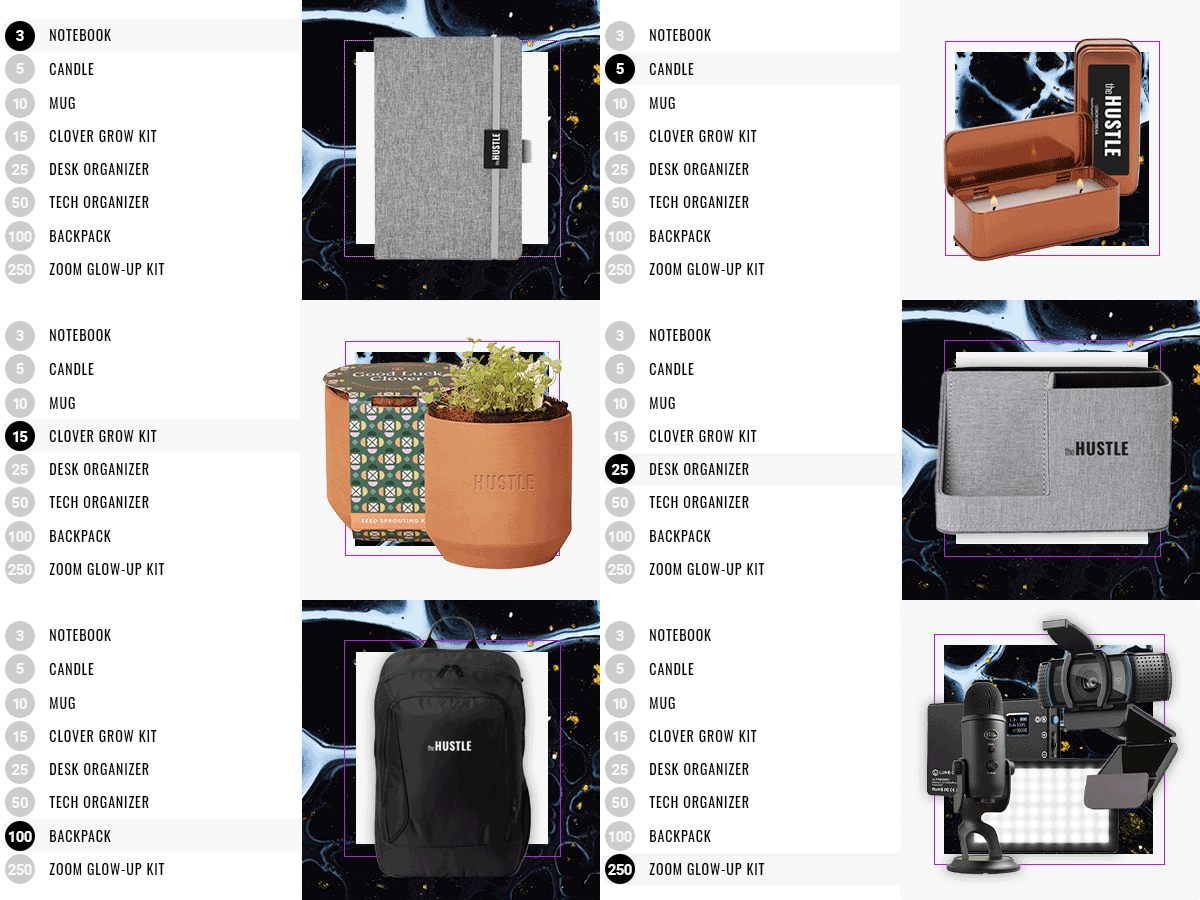
Refer just 3 people and we'll send Hustle essentials as a thank you.
Today’s Fit the Bill answer is Fidelity Investments (private company; manages $12.6T in assets)
Today's email was brought to you by Juliet Bennett Rylah and Sara Friedman. Editing by: Ben “Give me one hour and a spoon, and chocolate chip ice cream will be back on top” Berkley.