Hello readers!
Welcome back to Launchpad. We’re in the depths of winter here in Chicago, and I’m really missing my garden. This got me thinking about plants in space – in my mind, the least pleasant thing about places other than Earth is that they don’t have trees (as far as we know). But scientists around the world are working on ways to grow plants in space and on other worlds, so someday that might change.
|
|
|
What's happening up there |
|
|
The Ingenuity helicopter’s Mars mission is over, but it left a legacy |
After nearly three years of exploring Mars, NASA’s Ingenuity helicopter has taken its final flight – but its astounding performance is a good sign for future drones on other worlds. Read more |
|
|
Galaxy smash-ups may explain strange light from early universe
|
Light from hydrogen in the early universe has baffled astronomers, but researchers have spotted interacting galaxies that could explain how it makes its way to us. Read more |
|
|
Japan's SLIM moon lander regains power nine days after botched landing
|
SLIM was put into hibernation after landing on the moon upside down, but it woke up when sunlight hit its solar panels. Read more |
|
|
There are many reasons aside from aesthetics to try growing things in space. The obvious one is to provide food to explorers, especially those on future long-duration trips beyond Earth, spent either in spacecraft or on other worlds such as the moon or Mars.
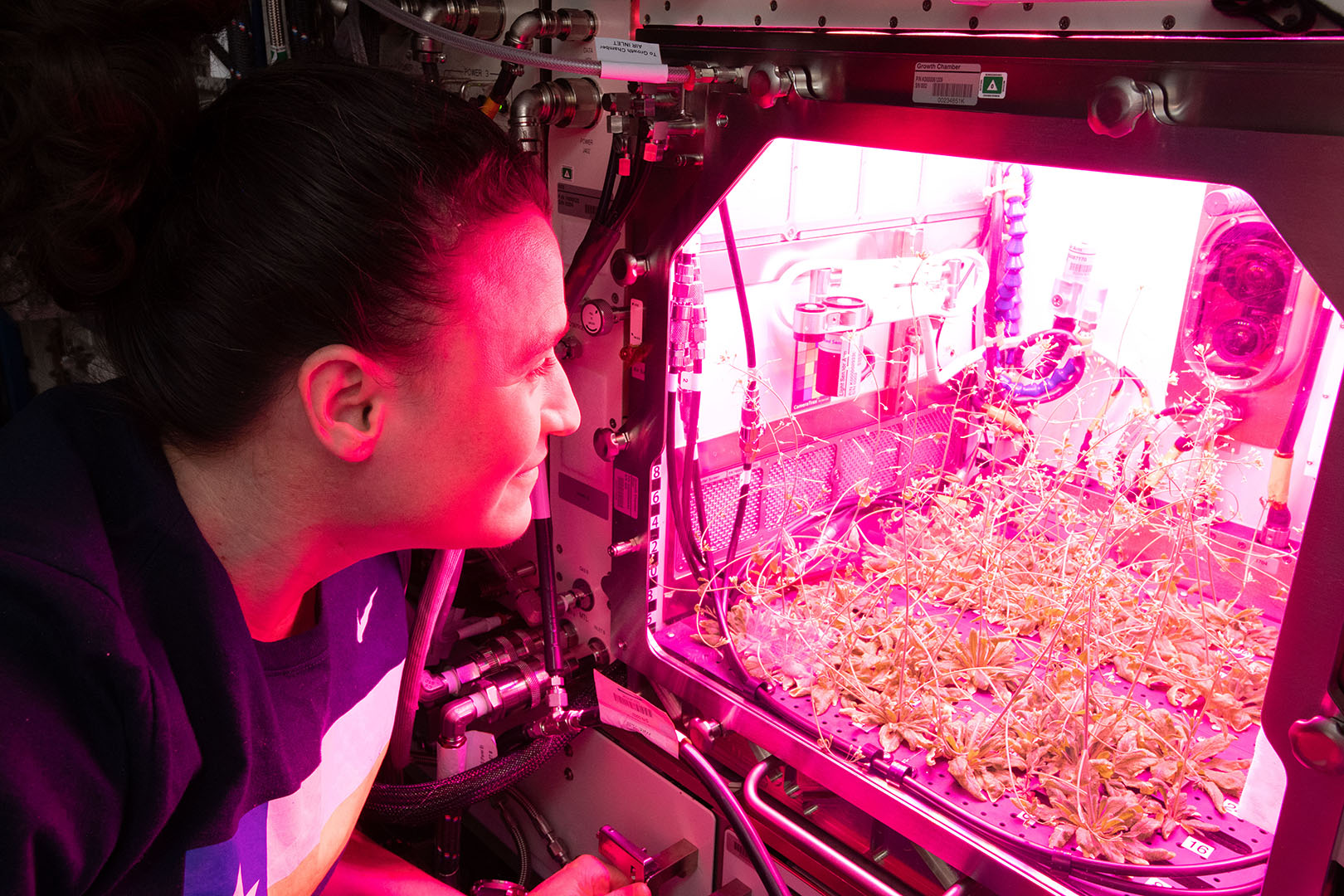
Another benefit for astronauts is psychological – numerous studies have shown that gardening, and even generally having plants around, can make people feel happier and calmer. As astronaut Christina Koch recently told me: “There were definitely days where I would go over to our tiny greenhouse, which is about the size of a couple of shoe boxes, and just smell the plants. Just to smell something that was organic, that actually did a lot for me.” You can imagine how looking into the vastness of space or the bleak landscape of Mars might be dispiriting, and seeing the greenery that we might take for granted on Earth could be comforting. The picture below shows the greenhouse on the International Space Station (ISS).
|
|
|
Plants also produce oxygen, and they can help make soil more fertile as generations of them grow and die. This could create a sort of feedback process that would make growing plants easier and easier over time.
But it’s going to start out difficult. For one thing, anywhere in space that we could send human explorers in the near future – meaning a space station, the moon or Mars – is cold and full of dangerous radiation. You can’t just go outside and plant a garden. “There are a few reasons you couldn’t just chuck plants on the moon – they wouldn’t survive the lunar temperature or the radiation,” says Jessica Atkin at Texas A&M University. “You’d have to grow them inside the habitat with the same protections as the astronauts.” That goes not just for the moon but for pretty much any other location in space, too.
On a spacecraft, that should be no problem – the whole thing is already shielded to protect astronauts. The main issue is the lack of gravity. Roots display a property called geotropism or gravitropism, meaning they grow in the direction of gravity’s pull. When they’re in microgravity, such as on the ISS, they grow in every direction and tend to strangle one another. Microgravity also makes it difficult to water plants, as the water does not trickle into the soil in the same way. Researchers on the ISS and around the world are working on potential solutions to those two problems, including developing special lighting rigs to direct growth and wrapping sponges around the plants’ roots.
On another world, there will still be gravity, so gravitropism shouldn’t be too big a problem. The issue there is soil. Moon dust and Mars dirt are both full of toxic compounds and lacking in essential nutrients. That’s where Atkin’s work comes in. She and her team have successfully grown chickpeas in lunar soil by adding a combination of worms to provide nutrients and fungus to remove toxins. The plants survived and flowered, a promising result.
But building an off-world greenhouse is more challenging. It would probably mean constructing an entire ecosystem almost from scratch, with all sorts of other organisms and special equipment to make anything grow. “You need all of these other things for plants to thrive,” says Atkin. “I think a lot of the time people don’t see what’s going on underneath the ground and what a productive little world is down there contributing to our plants.” Astronauts will probably bring most of their food with them for the foreseeable future, and maybe they’ll be able to supplement their diets with a few small vegetables or fruits. “It’s not going to be a salad bar anytime soon,” says Atkin. But maybe someday! |
|
|
| Get access to our expert coverage of the latest breakthroughs in science, including the search for a clean wonder-fuel that could speed our path to net zero. |
|
|
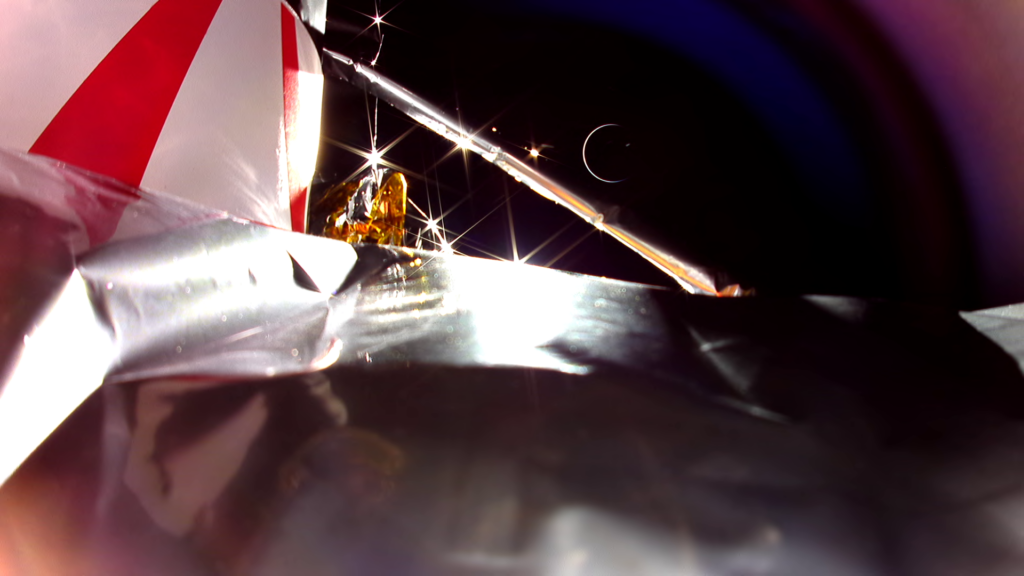
This was one of the final images sent back to Earth by the doomed Peregrine lander, a spacecraft from US company Astrobotic that was intended to go to the moon. It started experiencing issues just a few hours after its 8 January launch, which were eventually traced back to a major fuel leak. By the time the leak slowed, there wasn’t enough fuel left for it to land on the moon, so on 18 January it came back to Earth and burned up in the atmosphere. It’s the third attempt by a private company to land a craft on the moon. So far none of them have succeeded, however, and that big “first” is still up for the taking.
|
|
|
A reader wrote in to ask: “What meaning is there to the observation that the solar system is sort of planar?” Everything in our solar system is pretty well organised – the planets all orbit in the same plane along which the sun rotates, and they mostly rotate parallel to that plane (with some variations, especially in the ice giants). Most of the moons also orbit their planets in that same plane.
What we now know – both from that planar architecture and from observations of other planetary systems in the midst of formation – is that the solar system began as a disc of dust and debris orbiting the sun. The sun formed from a cloud of dust, and the initial rotation of that cloud gave our star and its protoplanetary disc their spins. As the dust clumped up into planets, they orbited and rotated in the same direction as the initial cloud because of the law of conservation of momentum – all that energy from the initial motion had to go somewhere, and it went into making everything orbit and rotate. When things don’t follow the planar pattern, such as Uranus with its severely tilted spin, we generally chalk it up to some major collision or other event that happened since the solar system’s formation. So, the rule teaches us about our solar system’s history, and the exceptions are equally informative.
|
|
|
This month, I have two long reads to recommend! The first is an interview I did with astronaut Christina Koch, who has spent the longest time in space of any woman. She’s getting ready to travel around the moon on the Artemis II mission, which is currently scheduled for 2025, but my favourite parts of the conversation were about everyday life on the ISS. She told me about the smell of space, what astronauts do for fun up there and how it felt to come home. Read more
The second is an interview with cosmologist Jim Peebles, whose books I read long before I decided to be a journalist instead of an astronomer. The man knows more about the universe writ large than almost anyone, so if you’re interested in cosmology this is a must-read. In the interview, Peebles spoke about the biggest questions facing modern cosmology, the anomalies confusing scientists around the world and the prospect of finding a theory of everything. Read more
|
|
|
Thank you for reading! If you have any comments, questions or wild hypotheticals about space, let me know by emailing me at launchpad@newscientist.com and I’ll try to answer them in an upcoming newsletter. And remember… if you planted an indestructible grapevine on Earth that stretched all the way to the moon, and it fruited the same way it does on Earth, it would produce around 250,000 tonnes of grapes, as a very general estimate. That’s enough to make more than 200 million bottles of wine, but it’s still less than 1/150th of the world's annual wine production. |
|
|
This email has been sent to subscriber@example.com.
Unsubscribe from the Launchpad newsletter |
Do not reply directly to this email. If you have an enquiry, please contact us using the relevant contact details listed here. |
Copyright © New Scientist Ltd
Registered Office: Northcliffe House, 2 Derry Street, London, W8 5TT
Registered in England. No.10644366
Australian mailing address: PO Box 2315, Strawberry Hills, NSW 2012, Australia
Registered in Australia. ABN 22 621 413 170
Privacy Policy | Terms & Conditions |
|
|
|
|
|
|