Hi there,
I’ve recently returned from the COP28 climate summit in Dubai in the United Arab Emirates where the world’s governments recognised that tackling climate change requires transitioning away from fossil fuels. The convention centre was full of people milling around talking enthusiastically about the “end of the fossil fuel era”.
While fossil fuels dominated attention there (see our coverage here), for this month’s Fix the Planet I wanted to focus on another issue that took up much of the discussions: adaptation. The climate has changed already. What is needed to make our infrastructure, our agriculture and our ecosystems more resilient to those changes? There are myriad possibilities for how we might adapt. But all of them depend on having reliable, up-to-date information about the climate. Billions of people who live in areas without basic weather observations lack this information, leaving them less prepared for ever-increasing extremes.
One effort that could help is a first-of-its-kind collaboration between more than 20 of the world’s meteorology centres to install weather stations across the planet, each one filling a gap that will help improve forecasts for everyone. But first... |
|
|
This month's top environment stories |
|
|
Australian Associated Press/Alamy |
|
|
World predicted to break 1.5°C warming limit for first time in 2024 |
There is a reasonable chance 2024 will be the first year in which the average global surface temperature is more than 1.5°C above that of the pre-industrial period, the UK's Met Office forecasts. Read more |
|
|
Ancient climate analysis suggests CO2 causes more warming than thought |
A reconstruction of 66 million years of climate history indicates global temperature may be even more sensitive to carbon dioxide levels than current models estimate. Read more |
|
|
COP28 deal has loopholes that could weaken its impact on emissions |
An agreement reached at the COP28 climate summit mentions transitioning away from fossil fuels, but contains weak points that could limit our ability to keep the world from warming beyond 1.5°C. Read more |
|
|
Weekender: Science of the Jurassic Coast, Dorset and Devon, England
Discover the science of the Jurassic Coast, from the ever-changing landscapes to the future of beaches and geology, with insights from geologists, marine biologists and conservation experts. 17 - 19 May 2024
Find out more |
|
|
“Yesterday was a catastrophe,” said Ladislaus Chang’a at the Tanzania Meteorological Authority, speaking to a crowd at COP28 on 4 December. The day before, heavy rains in northern Tanzania triggered mudslides that killed more than 63 people and injured more than 100 others.
But even as rescue operations continued, Chang’a said his mind was on another problem. “The thing that is frustrating me more, as a meteorologist, is that we aren’t able to determine and quantify the amount of rainfall that landed in that area because we do not have observation data,” he said. That makes it more difficult to prevent such disasters.
Tanzania is among more than 100 countries that lack the basic weather observations needed for reliable forecasting. As weather becomes more extreme and less predictable with climate change, that is more than a matter of getting caught in the rain. It leaves people vulnerable to storms, heatwaves, droughts and other climate-related threats, says Markus Repnik at the World Meteorological Organization (WMO). “In some parts of Africa, it is not possible to predict if there is going to be more rain or less rain, because there is no data there,” he says. Repnik is the energetic director of an initiative of the WMO and the met offices of 28 countries trying to fill in that data gap by systematically building and refurbishing hundreds of weather observation stations around the world in the places that need them most. This data will then feed into the global circulation models that underpin weather and climate prediction everywhere.
“The first beneficiaries are people living in areas where there is no data,” says Repnik. “The second group of beneficiaries is everyone.” |
|
|
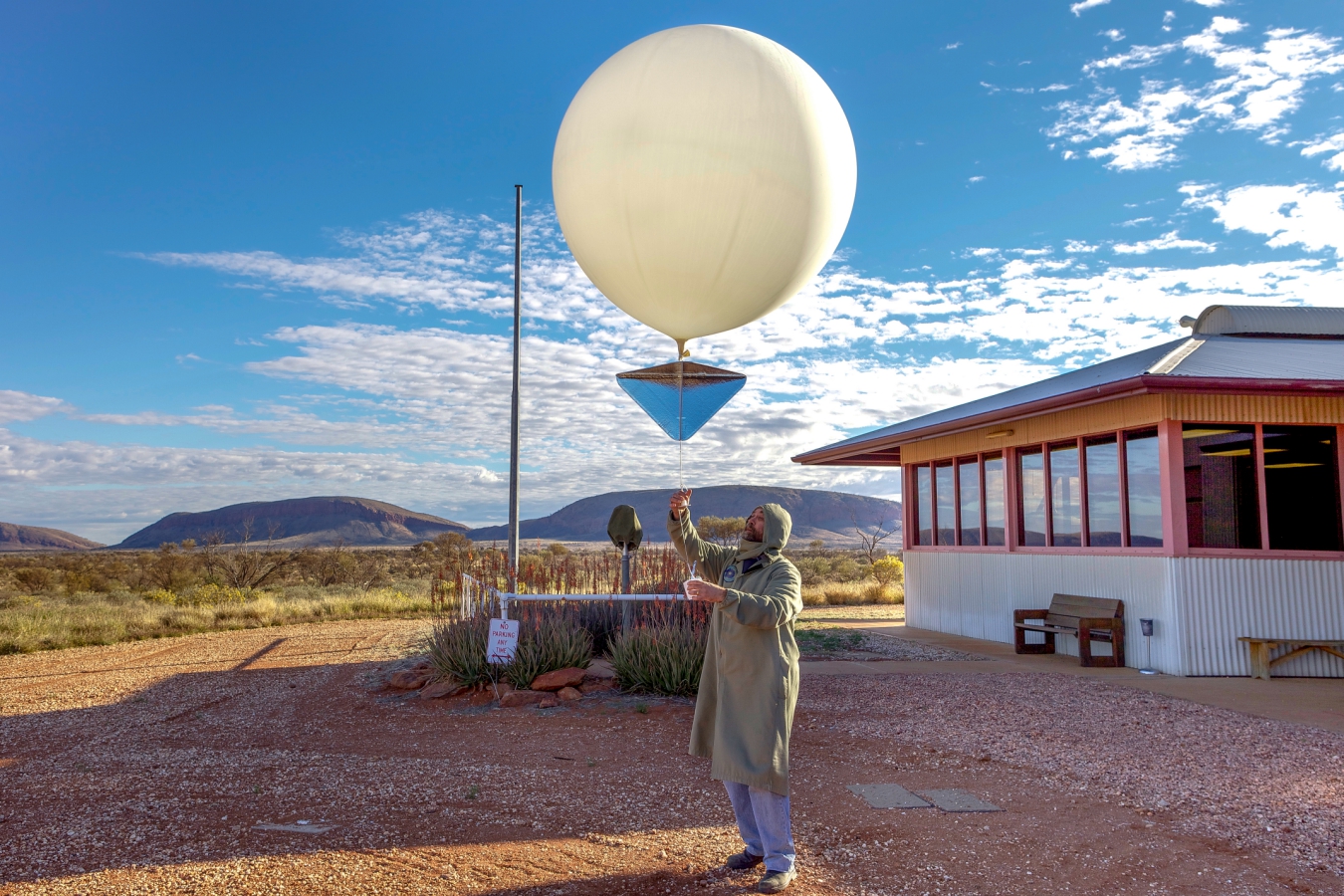
Weather balloons provide vital data for accurate forecasting |
Edward Haylan/Shutterstock |
|
|
The initiative was launched last year as part of a larger UN push to ensure universal access to early warning systems for extreme climate events. Such systems are known to be among the most effective ways to help prevent deaths and damage due to climate extremes, yet more than a third of people aren’t covered by them, primarily in low-income countries in the global south.
“Vulnerable communities in climate hotspots are being blindsided by cascading climate disasters without any means of prior alert,” said UN secretary-general António Guterres, while speaking about the need for early warning at COP27 in Egypt last year. Early warnings aren’t a substitute for other forms of climate adaptation, but they can make a big difference. According to the UN, just 24 hours of notice of a coming event can reduce damage by a third. Disasters kill eight times fewer people in countries with strong warning systems than those without.
The need for early warning also got a nod in the new “Global Goal on Adaptation” agreed at COP28, which was the top priority for many countries at the summit. This calls for every country to have early warning systems in place by 2027, as well as to collect the observations that form the basis for those warnings. “Early warnings can only be as good as the data they are built upon,” says Repnik. |
|
|
So how much data is needed? Starting this year, the World Meteorological Congress, the governing body of the WMO, has required every country to have a surface weather station that supplies public weather data every 200 kilometres and a weather balloon station to take measurements high in the atmosphere every 500 kilometres. That is meant to supply an open global database for better weather forecasts and other climate applications, such as attributing a particular extreme event to climate change.
More than 100 low-income countries, mostly in Africa and south and South-East Asia, deliver just 7 per cent of this minimum surface weather data and just a quarter of the weather balloon data, according to a WMO report. Some countries collect more than that, but don’t share it publicly; others don’t have the stations needed to take those measurements. Together, data gaps in those countries account for about half of the missing data globally.
Repnik says closing that gap worldwide would require installing about 600 surface weather stations and 140 weather-balloon stations. Many more stations would be needed to provide the high-resolution forecasts taken for granted in high-income countries, but Repnik says minimum requirements need to be met before building higher density networks.
Most of those stations will have to be purchased and installed. But some of them already exist and just needed refurbishing. “There is huge untapped potential,” says Repnik. For instance, he says some past philanthropic efforts installed stations that now sit unused for lack of continued support. To avoid that happening, Repnik says the WMO programme is set up to support people and stations over the long term.
Nirivololona Raholijao, who directs Madagascar’s national meteorological service, offered an apt illustration of the need for such support at COP28. In 2022, one weather station at an airport in Madagascar’s southern tip was destroyed by a tropical cyclone. Its replacement was destroyed by Cyclone Freddy this year. Now the WMO is helping to install another. “It is not just to fill the gap,” said Raholijao. “Sustainability is really, really a big challenge.”
|
|
|
In its first year and a half, the WMO programme has developed plans with more than 50 countries to identify where more weather observation facilities are needed, and suitable places to install them. In November, the first investments were approved to begin building stations in six countries in 2024. Those are Belize, Kiribati, the Maldives, Mozambique, Rwanda and South Sudan, the last of which currently delivers no public weather data. So far, the programme has also raised around $80 million of the $400 million Repnik estimates is needed to completely close the data gap. Once complete, it would take about $50 million a year to pay people to run and maintain those stations. While that might sound expensive, Repnik points out that the returns are far greater, both in terms of the damage they help prevent and the data they produce.
“Reporting from stations in remote areas of the globe contributes to global forecast quality up to 20 times more than any single station in continental Europe,” says Florence Rabier, director of the European Centre for Medium-Range Weather Forecasts. In exchange for that valuable data, the centre supplies its global forecasts at no cost to countries participating in the WMO programme. “The global weather models and the supercomputers on which they are running need a reflection of the state of the Earth at any given moment in time,” says Repnik. Right now, many of the most vulnerable parts of the planet are only a fuzzy picture. |
|
|
| To make their nighttime journeys, reindeer have evolved the ability to shift their eye colour as the seasons change to see better in the dark. Read about this and other wonders of the natural world with a New Scientist subscription. |
|
|
Governments should be aiming to trigger technological, economic and social tipping points that accelerate climate action, according to a major report. Read more
Seagrass is a habitat that buries carbon up to 35 times faster than tropical rainforest. Here's a video about an effort to restore it in the Thames estuary in the UK.
Billions of dollars are pouring into the carbon dioxide removal industry, which aims to clean up emissions and slow global warming, but few companies have delivered results. But is it a planetary saviour or a risky bet? Read more
| |
|
This month's long read: Arctic cowboys |
|
|
By 2030, half of the world’s population will face severe water shortages. Yet, there are vast amounts of drinking water locked away in polar ice caps. Dreams of tapping into this resource by towing icebergs from the poles to warmer climes have a long history. Fanciful as iceberg wrangling may sound, we are on the verge of being able to make it a reality. But just because iceberg wrangling is possible, doesn’t mean it is a good idea. Read more
|
| |
That's all from us in 2023. Thanks so much for being a loyal reader of Fix the Planet. Please do reach out to me with any ideas, questions, comments or curiosities at james.dinneen@newscientist.com. We'll be back in your inbox with more fixes in the new year. Happy holidays! |
|
|
This email has been sent to subscriber@example.com.
Unsubscribe from the Fix the Planet newsletter |
Do not reply directly to this email. If you have an enquiry, please contact us using the relevant contact details listed here. |
Copyright © New Scientist Ltd
Registered Office: Northcliffe House, 2 Derry Street, London, W8 5TT
Registered in England. No.10644366
Australian mailing address: PO Box 2315, Strawberry Hills, NSW 2012, Australia
Registered in Australia. ABN 22 621 413 170
Privacy Policy | Terms & Conditions |
|
|
|
|
|
|