By C. Theodore Hicks II, CFP®, CKA®, CMT®
|
|
|
1/ Soft Landing Increasingly Likely |
2/ But the Dollar Has Helped |
3/ Ignore the Narrative, Buy theTrend |
|
|
Investopedia is partnering with CMT Association on this newsletter. The contents of this newsletter are for informational and educational purposes only, however, and do not constitute investing advice. The guest authors, which may sell research to investors, and may trade or hold positions in securities mentioned herein do not represent the views of CMT Association or Investopedia. Please consult a financial advisor for investment recommendations and services. |
|
|
Soft Landing Increasingly Likely |
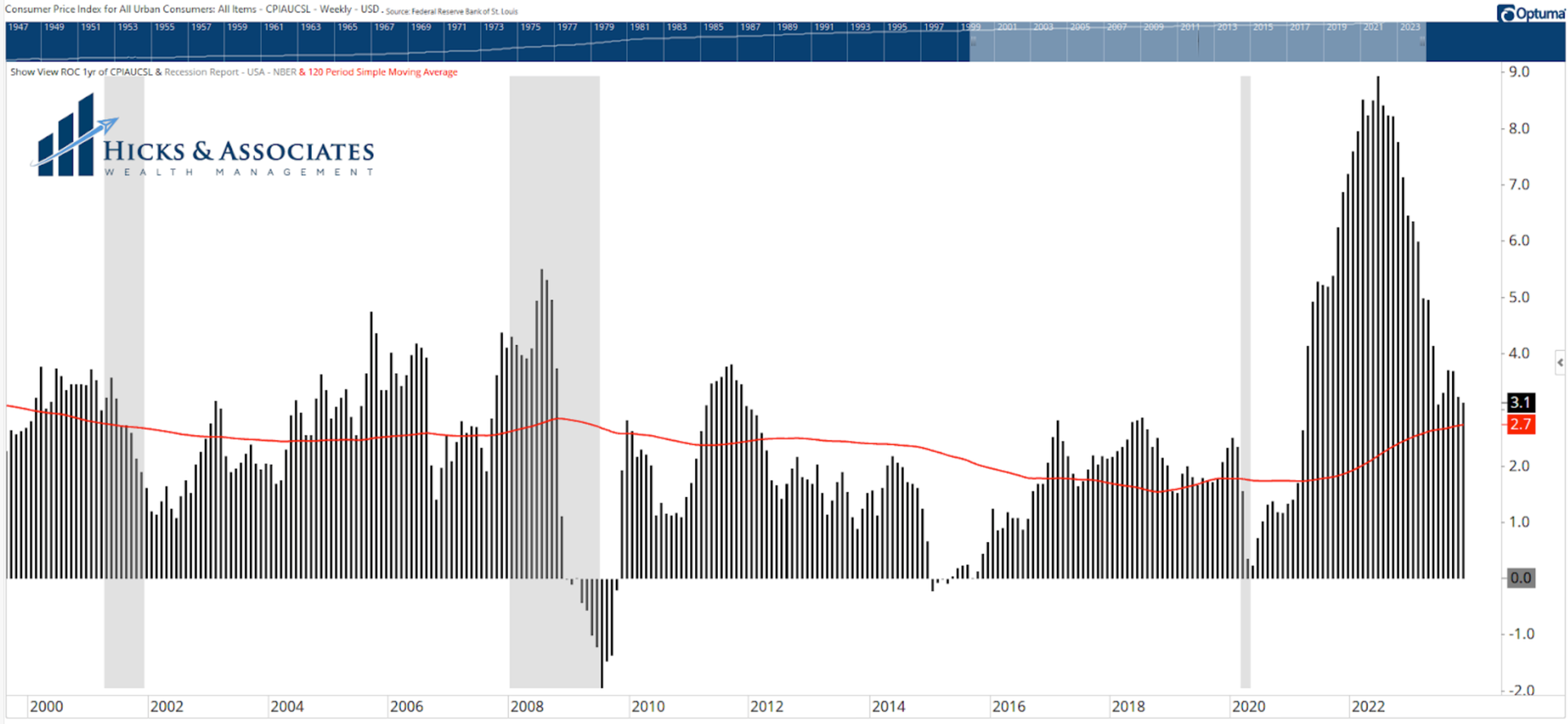
Broadly speaking, there are two main types of analysts in the financial markets. There are fundamental analysts and technical analysts. (If you are not familiar with the distinctions, you can review the Investopedia article Fundamental vs. Technical Analysis: What’s the Difference?) As CMT Charterholders, my Investment Committee and I definitely have a bias towards technical analysis. However, we do utilize both fundamentals and technicals. Chart 1 could be considered a bit of both. Here we are displaying the Consumer Price Index since the turn of the century. The red line is the 10-year average which is showing a current reading of 2.7%. The latest CPI data point came in at 3.1%. If, and this is indeed a big “if”, the CPI stays in this range, we have to give a hat-tip to Chairman Powell and the Gang - sorry, I meant "and the Fed Board of Governors." (But Chairman Powell and the Gang sounds so much better. It should be the name of a band!) Joking aside, inflation got way out of control and, for now at least, it seems Chairman Powell has done a fantastic job of bringing inflation back down ... and really close to the 10 year average. There are other data points that suggest the battle is not quite won; in other words, there is a very real risk that we could see another spike back up. But, for now, it appears that Chairman Powell has done a good job. Could he have done better? Of course. Hopefully, we all are willing to admit that we have room for improvement and we could implement 1% better the next time. But, for now, it appears increasingly likely that Chairman Powell and the Fed may have just engineered a "soft landing". For now, to him, I would say, "Well done, sir." This realization, that the Fed may have very well engineered a “soft landing”, is one of the reasons the U.S. stock market has experienced a very substantial rally since November 1st. |
|
|
Financial market research from professionals at the forefront of technical analysis innovation. |
|
|
But the Dollar Has Helped |
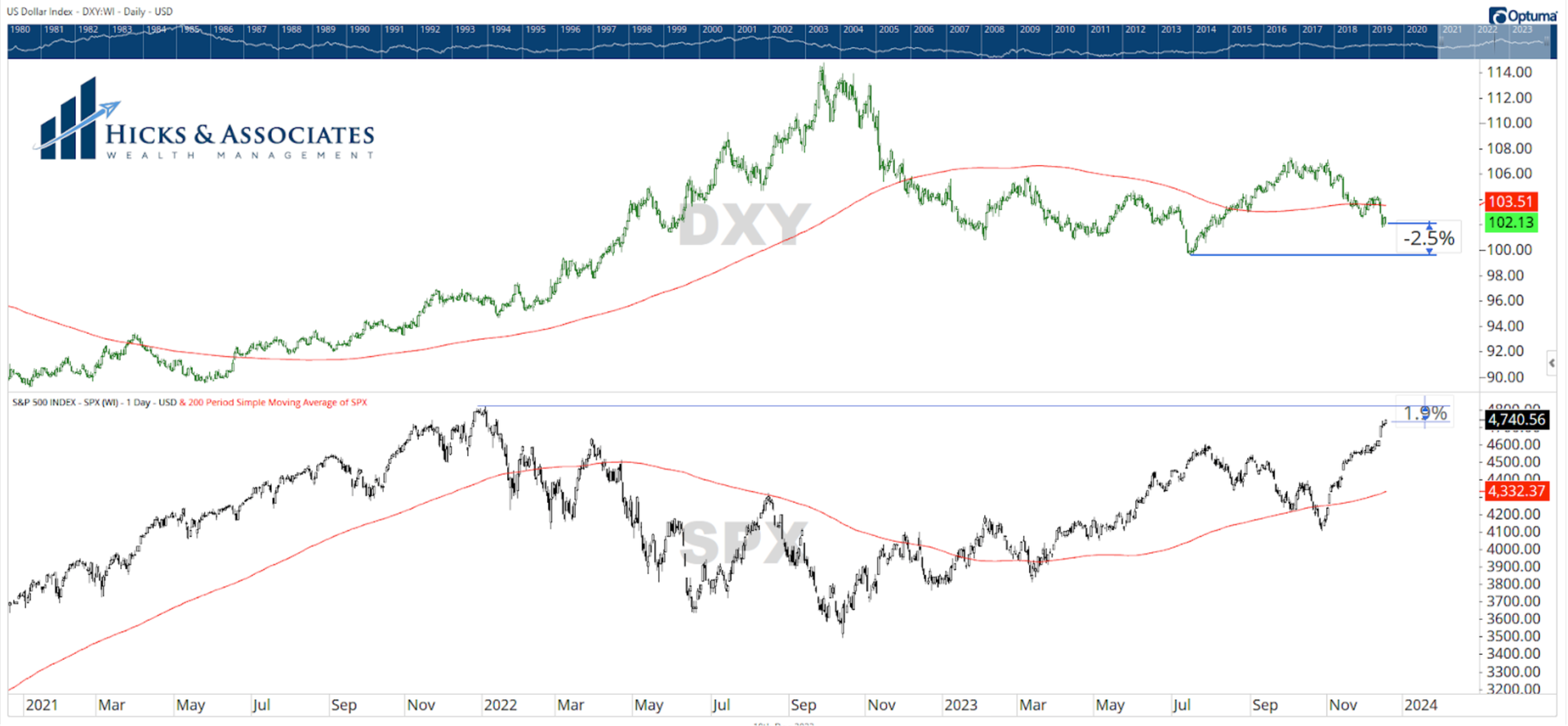
While that is true, Chart 2 shows us that the US dollar has helped. The top pane of our second chart is the US dollar. The bottom pane is the S&P 500. Generally speaking, the US stock market is inversely correlated to the US dollar. When the dollar goes up - reference 2022 - the stock market goes down. When the dollar goes down, the stock market goes up. This is not always true, but it is generally true. (This is an example of Intermarket Analysis. What is Intermarket Analysis? Read this Investopedia article.) Since the start of November, the US dollar has gone down. Meanwhile, since the start of November, the US stock market has gone up. The correlation continues. What can we glean from this chart? If you look closely, I’ve added a price measurement to both the dollar index and the S&P 500. For the dollar, it is approximately 2.5% away from the most recent significant low from July 2023. Meanwhile, the S&P 500 is approximately 1.9% away from the all-time high of December 2021. When a stock or an index reaches a prior low or prior high, that level can act as a resistance or support. While we do not know what will happen when these levels are reached, it is reasonable to expect some degree of a pause or a battle before a breakthrough of that level. But since the DXY is below its 200-day moving average and the S&P 500 is above its 200-day moving average, it is reasonable to expect that the general direction (down for the dollar and up for stocks) would continue. |
|
|
Ignore the Narrative, Buy the Trend |
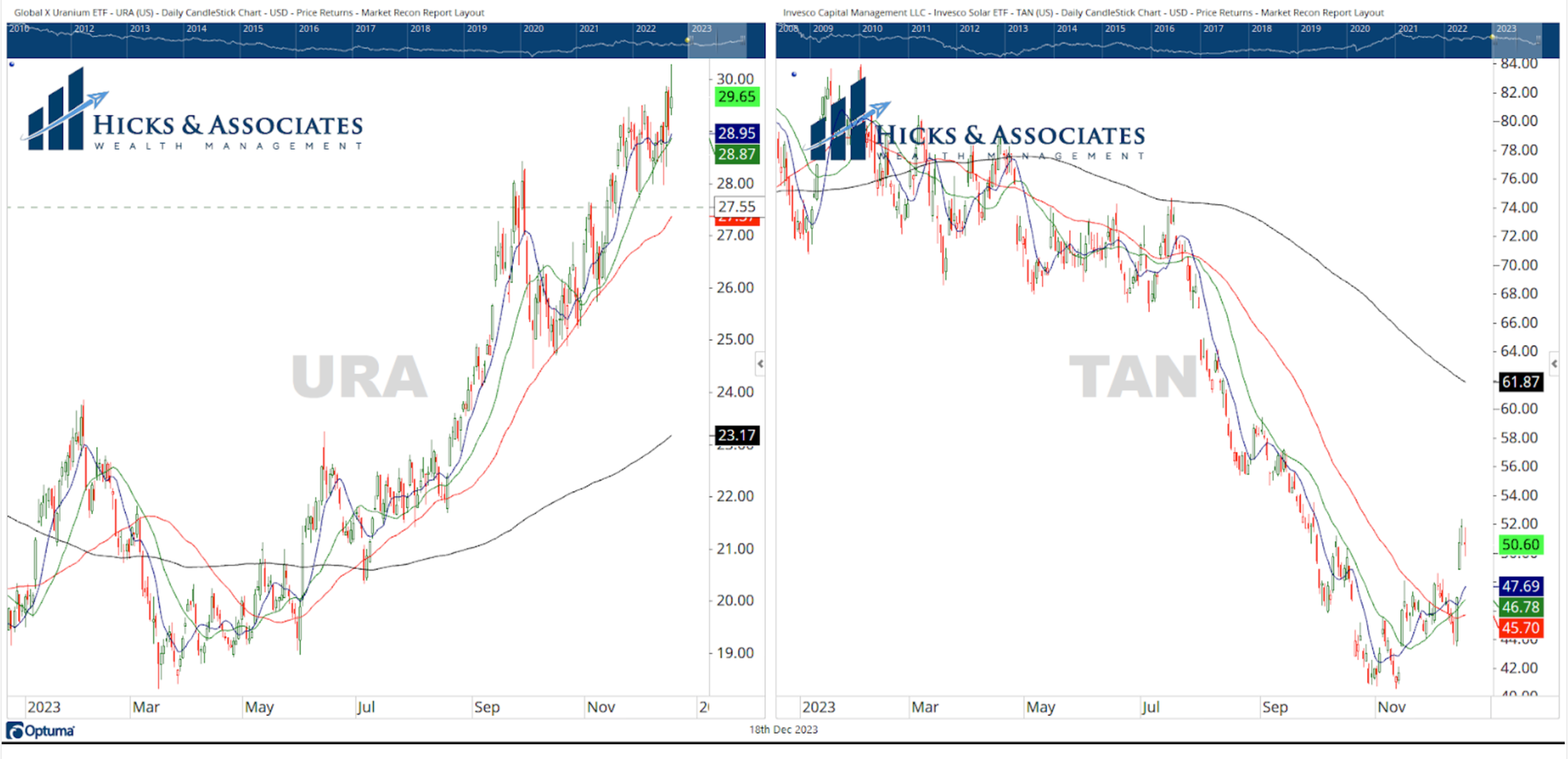
One of the reasons we have a bias towards technicals over fundamentals is because “price never lies”. (Hat tip to you, Ralph Acampora.) Sometimes, a fundamental analysis might lead us to believe what could happen in the days, months or years ahead. From our point of view, our experience tells us that clients do not care about what might happen. They care about what is happening. Here we are showing two charts. A uranium ETF is on the left. On the right, we have a solar ETF. How many articles have you seen about “green” energy over the last year or two? Now, how many of those articles have mentioned solar energy versus how many have mentioned nuclear energy? The point that I am trying to make with this side by side comparison is that we have a bias towards technical analysis as technical analysis ignores the narrative. Every CEO wants to create a positive story around his company and why investors should continue to invest in his company. (And, no, I’m not being sexist. I’m simply referring to the traditional definition of “man” in a Proto-Germanic sense; i.e. gender neutral.) However, that narrative is just a story. Sometimes stories are true. Sometimes they are fiction. But price never lies. So, we present this side-by-side view of a nuclear ETF and a solar ETF. Most are familiar with the solar story. But would you want to invest in it? Or would you rather invest in the uranium story? Ignore the narrative and buy the trend. |
| |
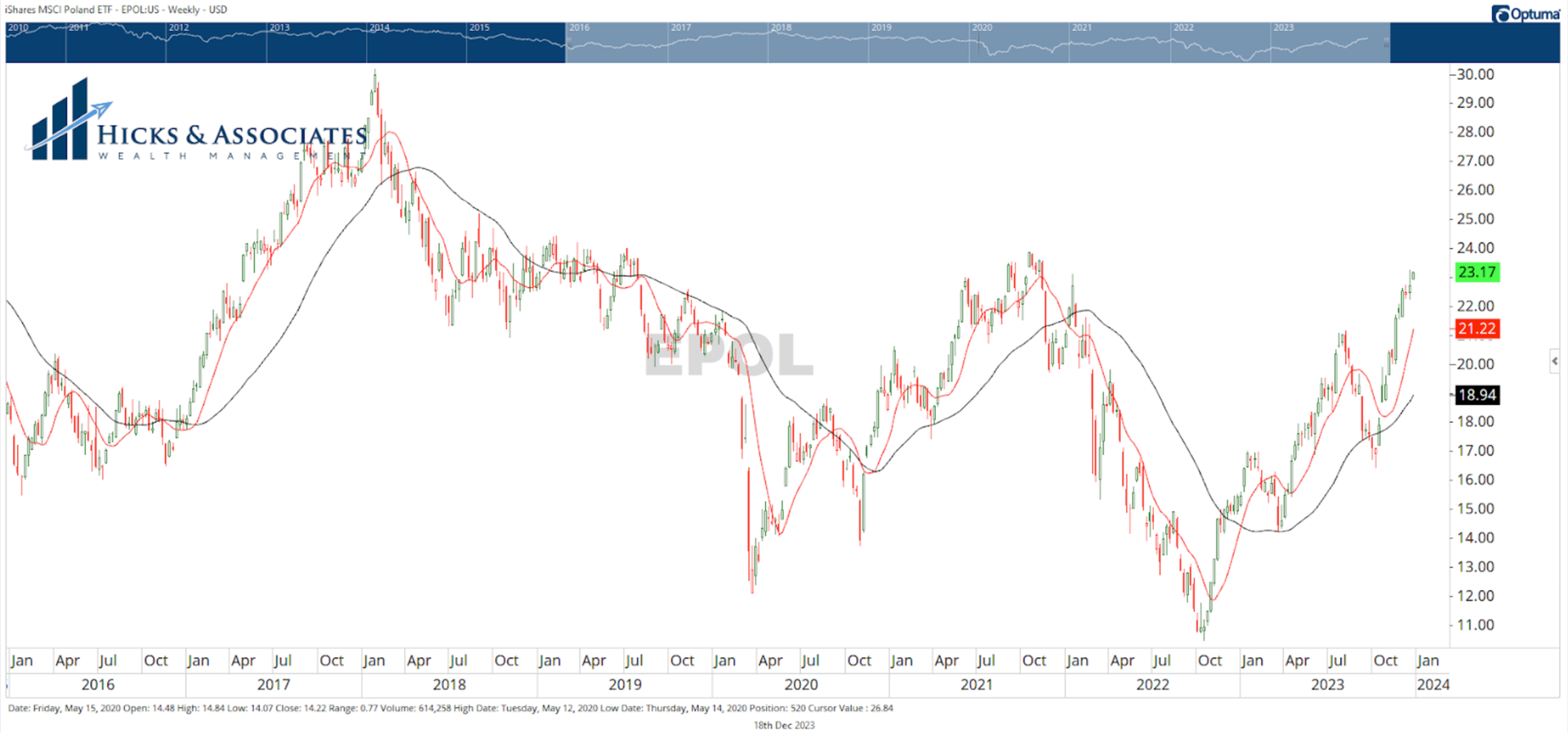
To continue the point about ignoring the narrative and just buying the trend, which country was the better place to park your hard earned dollars in 2023, the United States or Poland? Without consulting the data, not many would likely guess Poland. But Poland, as measured by EPOL, is up ~47.58% year-to-date while the S&P 500, as measured by SPY, is up “only” 23.94% year-to-date. Out of the single-country ETFs that we follow, EPOL is on top for year-to-date performance. Unfortunately, we cannot say that our clients are invested in Poland as we have not seen a clean, low-risk entry. The chart for EPOL is shared simply to help drive home the point that we should ignore the narrative and just buy the trend. That said, this is also an example of how important it is to know what you are buying. EPOL consists of only 31 stocks. As a result, it is fairly concentrated. But, then again, many folks talk about “the Dow” likely not realizing that the Dow Jones Industrial Average consists of only 30 stocks. |
|
|
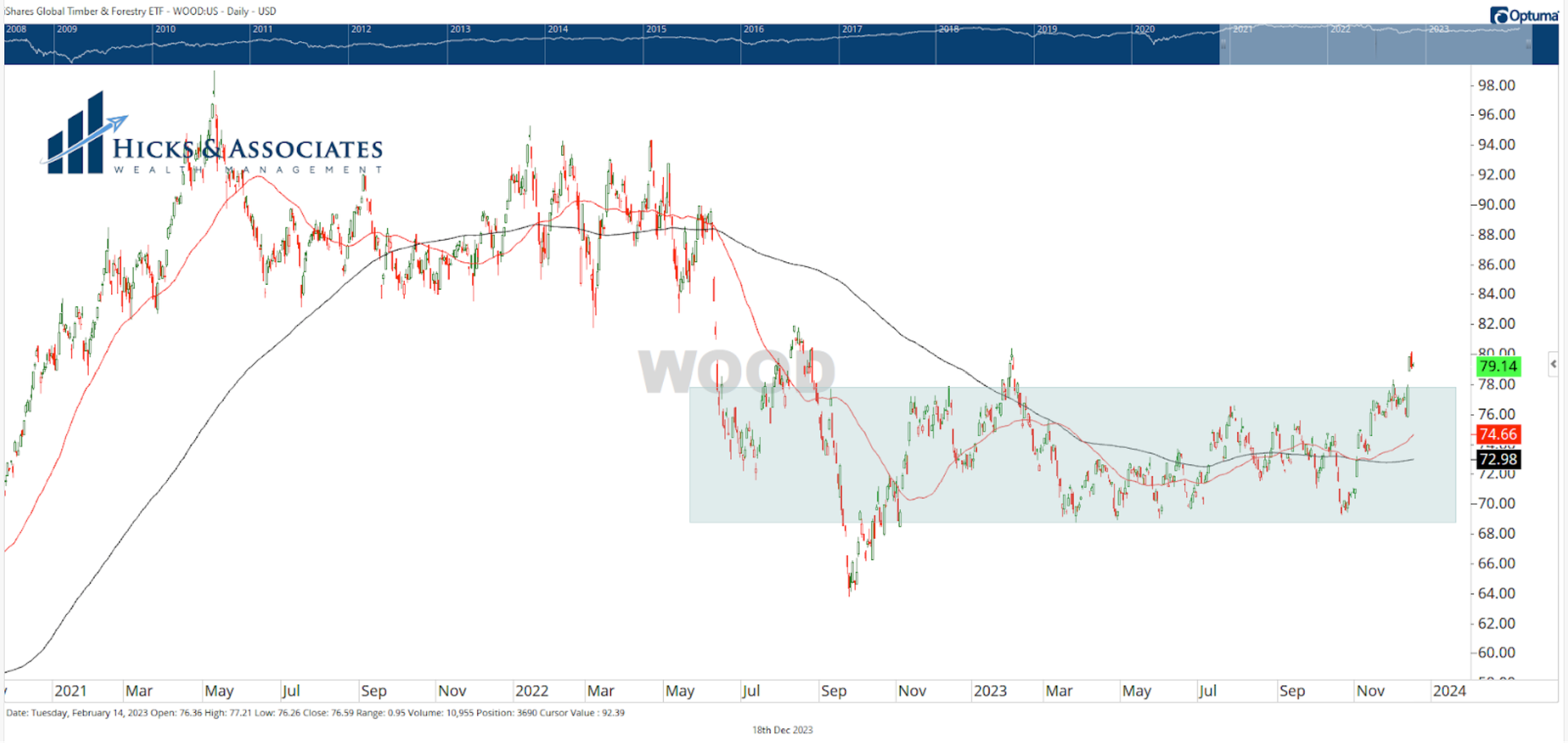
The final chart of the day is WOOD, which is the iShares Global Timber & Forestry ETF. I could - and perhaps should - write a dissertation on the fallacy of seeking “diversification”. Ultimately, neither I nor our clients want a “diversified” portfolio. We all want the same thing; a highly correlated portfolio. In a strong, positively trending market, we want our entire portfolio to be participating in that trend. In a weak, or negatively trending market, we want our entire portfolio protected. However, there is indeed wisdom in seeking some diversification for if you are invested heavily in tech stocks and tech ETFs and that sector shifts out of favor, you are going to be hurt - at least a little. As a result, there is some benefit to having some degree of diversification in your portfolio. WOOD is one option to consider. Many have written about gold. And indeed, the chart for gold is very interesting; it could easily break out of a multi-year range into new high ground - very exciting. However, when I examine my “commodities” watchlist, I see WOOD is ranked higher than GLD. That piques my curiosity and I check the chart. When I examine the chart, I see a clear basing formation which I have denoted by adding a light blue rectangle. Recently, WOOD has broken out of that base. While this is not (typically) the type of price action that we would buy, that is a beautiful base and I’ve made a note to debate this ETF with the Investment Committee today. P.S. The sub-title of this section being labeled “Pinewood Derby” is a nod to our son. His Awana group has again sponsored a “Pinewood Derby” event. Last year, Teddy wanted my help crafting his pinewood block into a Ford Mustang. He won 1st place for design, so that was pretty neat. This year he wants my help turning his block of wood into a Lamborghini Huracan! Wish us luck! |
|
|
Theodore Hicks, CMT is the Founder and Chief Investment Officer for Hicks & Associates Wealth Management, an SEC Registered Investment Adviser. Hicks and his team manage money for families and retail clients using a proprietary, multi-strategy investment process through a rules-based framework. Since most of their clients are either near or already in retirement, the process is designed to minimize downside risk. Hicks frequently posts charts and his thoughts to his LinkedIn and Twitter accounts. |
|
|
You are receiving this newsletter because you subscribed to the Chart Advisor newsletter. If you wish to unsubscribe, please click here. Dotdash Meredith 225 Liberty St, 4th Floor, New York, NY 10281
© 2023 All Rights Reserved. Privacy Policy | Terms of Service |
|
|
|