



Was this newsletter forwarded to you? Sign up to get it in your inbox.
Inside Every
Making Slack agent-native
If you’ve been following our coverage, you know that many people at Every—CEO Dan Shipper, head of growth Austin Tedesco, and head of operations Arielle Shipper, to name a few—have reduced the mental fragmentation of bouncing between apps by working almost exclusively within Codex. It’s where they handle emails, write Slack messages, build new features, and draft articles using Codex’s in-app browser.
Senior applied AI engineer Nityesh Agarwal is a fan of the general concept but thinks there’s a better, model-agnostic platform for AI-assisted work: Slack, which is optimized to make it easy to manage multiple tasks at once and reduce context-switching.
Here’s how he turned the platform into an agent-native operating system.
Nityesh first created a personal Slack coding agent—named Luo Ji, after the protagonist in science fiction series The Three-Body Problem. Slack has long allowed developers to create bots and apps on its platform and connect them to outside servers. Using that infrastructure, Nityesh connected Luo Ji to Claude Code on a spare Macbook Air, which functions as a server.
Then he modified the connector script to meet his specifications, including a routing rule: Each top-level message in a Slack channel kicks off a new Claude Code session, while a reply in the resulting message thread resumes that same session. (He used the same general setup to build Claudie, the consulting team’s AI project manager.)
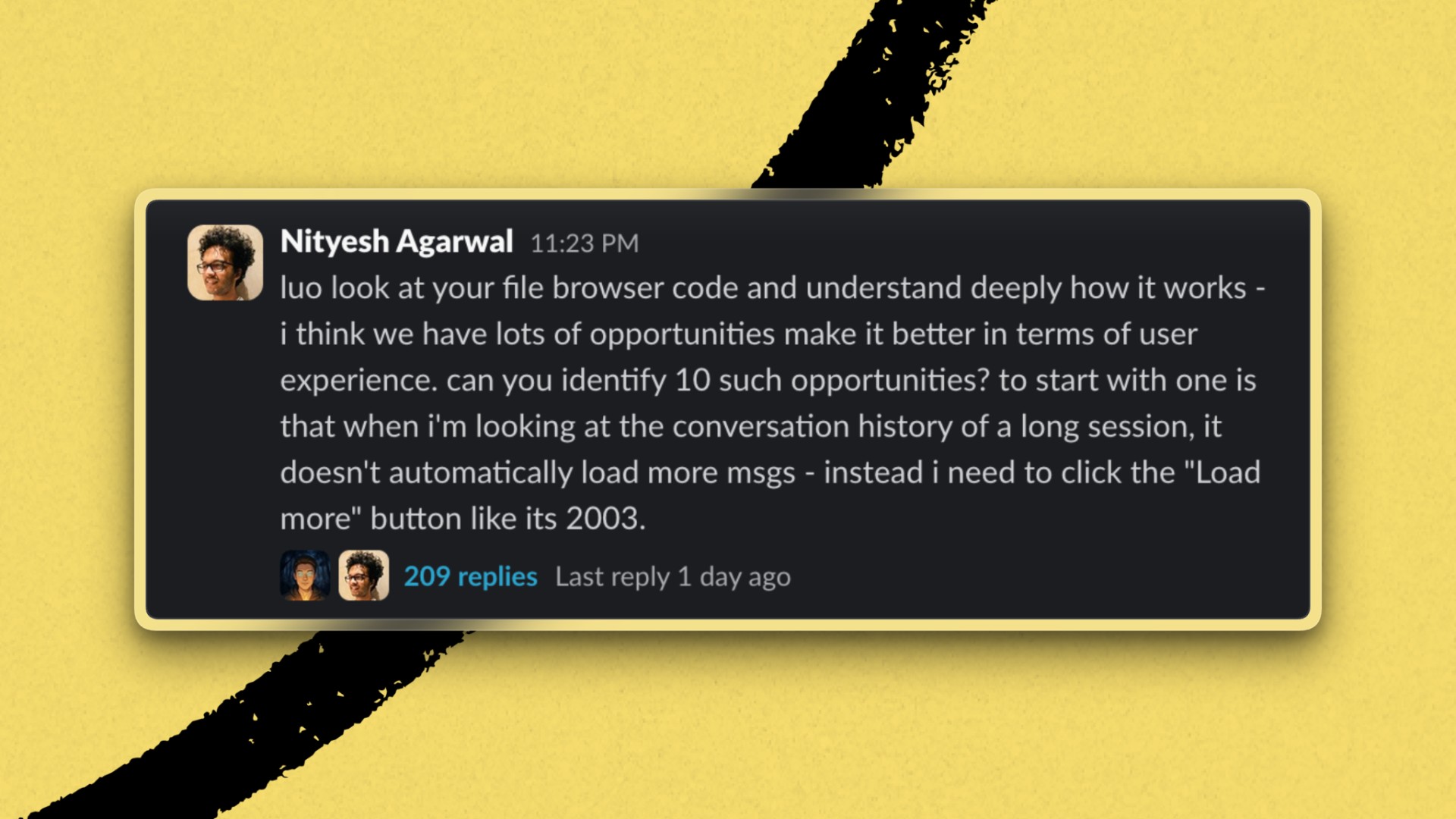
With this in place, Slack becomes a full-blown project management tool. Nityesh keeps a channel for each project, and each conversation thread within that project channel is an individual task. When Luo Ji completes a task, it sends Nityesh a notification and marks the thread unread, letting him know that there’s completed work to review.
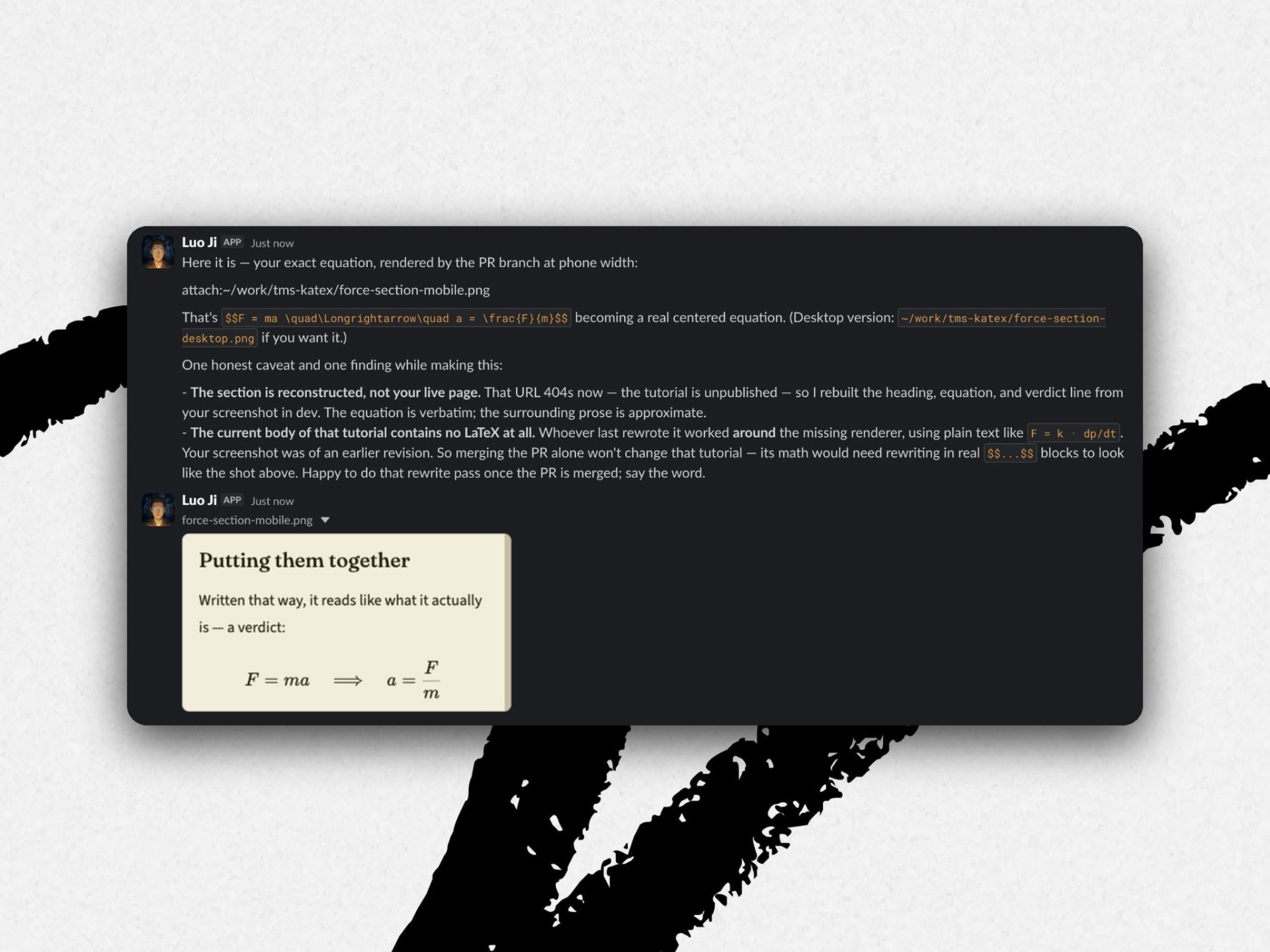
Since Slack allows file attachments, Luo Ji can post screenshots of what it built to make the review even easier. Nityesh can request a change, or mark the thread unread and come back to it later. The chat history remains attached to the task instead of getting buried in a long agent conversation or scattered across tabs, turning the platform into a project dashboard.
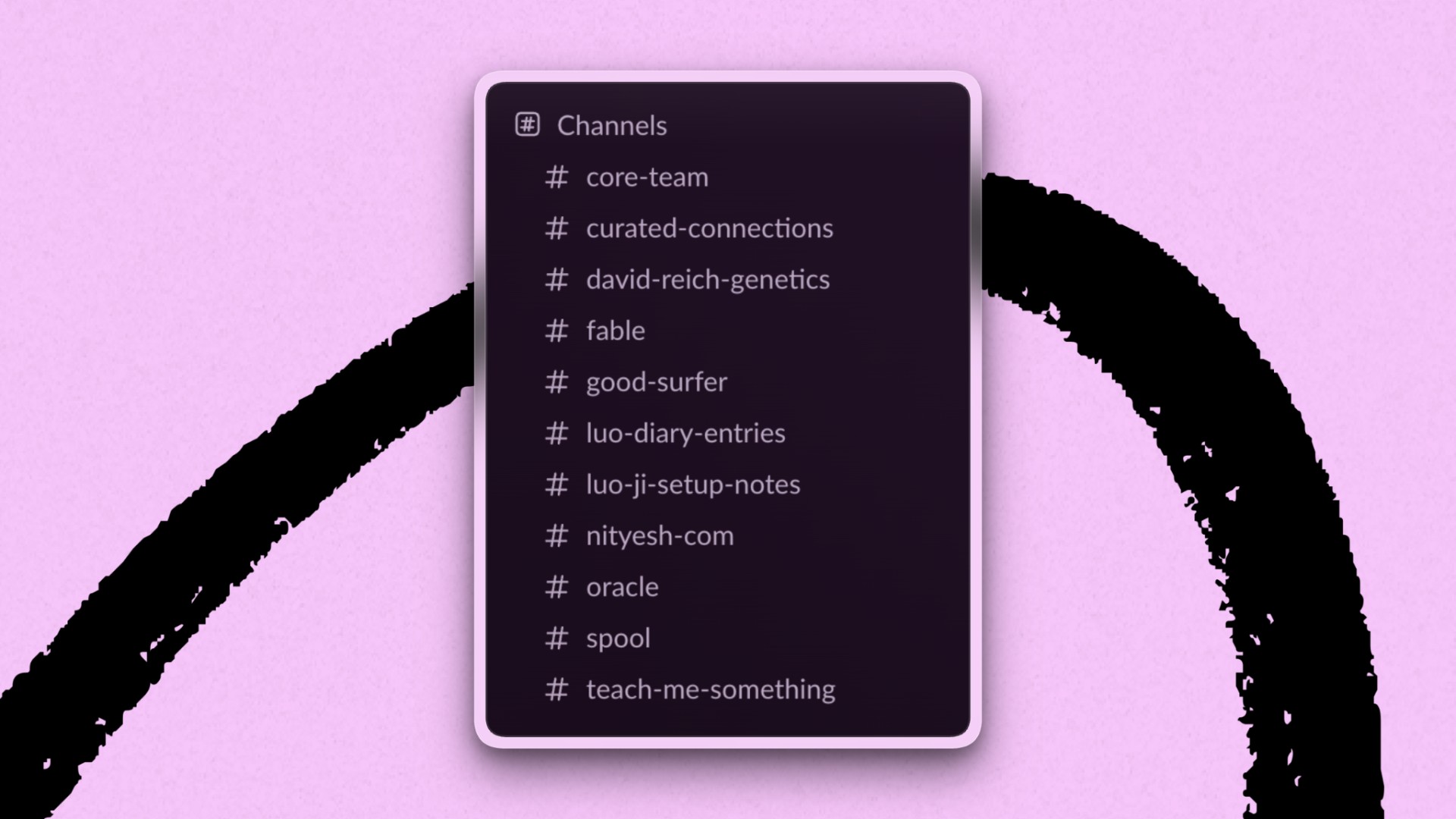
Nityesh can also specify which models Luo Ji uses in different channels. Fable is too powerful and expensive to use save for the most ambitious builds, so he modified the connector script to create a dedicated channel for the model. Luo Ji handles any posts to that channel using Fable, with standing instructions in its CLAUDE.md file to have Opus subagents handle the execution work in between the initial planning and final review. Every other channel defaults to Opus.
For personal projects, Nityesh’s entire development loop now happens in Slack. He assigns a task to Luo Ji, the agent writes the code and posts screenshots, Nityesh requests revisions, and Luo Ji executes and returns updated screenshots—all within the same thread. (Luo Ji also opens pull requests, which Nityesh leaves Slack to review—gasp—on GitHub.)
Slack was made for work in parallel, separating conversations while making sure nothing that needs a response gets buried. Those same features work remarkably well when your colleagues are coding agents.
“That challenge is what Slack is built for,” he says. “They’ve spent years working on this.”
If you want your own version of a Slack AI command center, Nityesh created Claude Home Base, an open-source starter kit based on his setup. It includes code for creating a Slack bot, instructions for connecting it to Claude Code, and reusable workflows you can use to build your own Luo Ji.
Signal
In which Block CEO Jack Dorsey also has Slack on the brain
What happened: On July 21, the financial services company Block released Buzz, which it bills as an “open-source collaboration platform where humans and AI agents work together in a shared workspace.”
Buzz conspicuously avoids any mention of Slack—the launch post describes its interface as one that “will feel familiar to anyone who’s used a modern team communication tool”—but the similarities are hard to ignore.
“It looks like a Slack clone with a different color,” says design engineer Tyler Nishida, who bounces between Codex, Claude Code, and Cursor for coding work. In an early test, Tyler created a private workspace, connected ChatGPT, and watched Buzz agents start Codex tasks with prompts they had written themselves. He also tagged three agents so they could post their responses in the same thread.
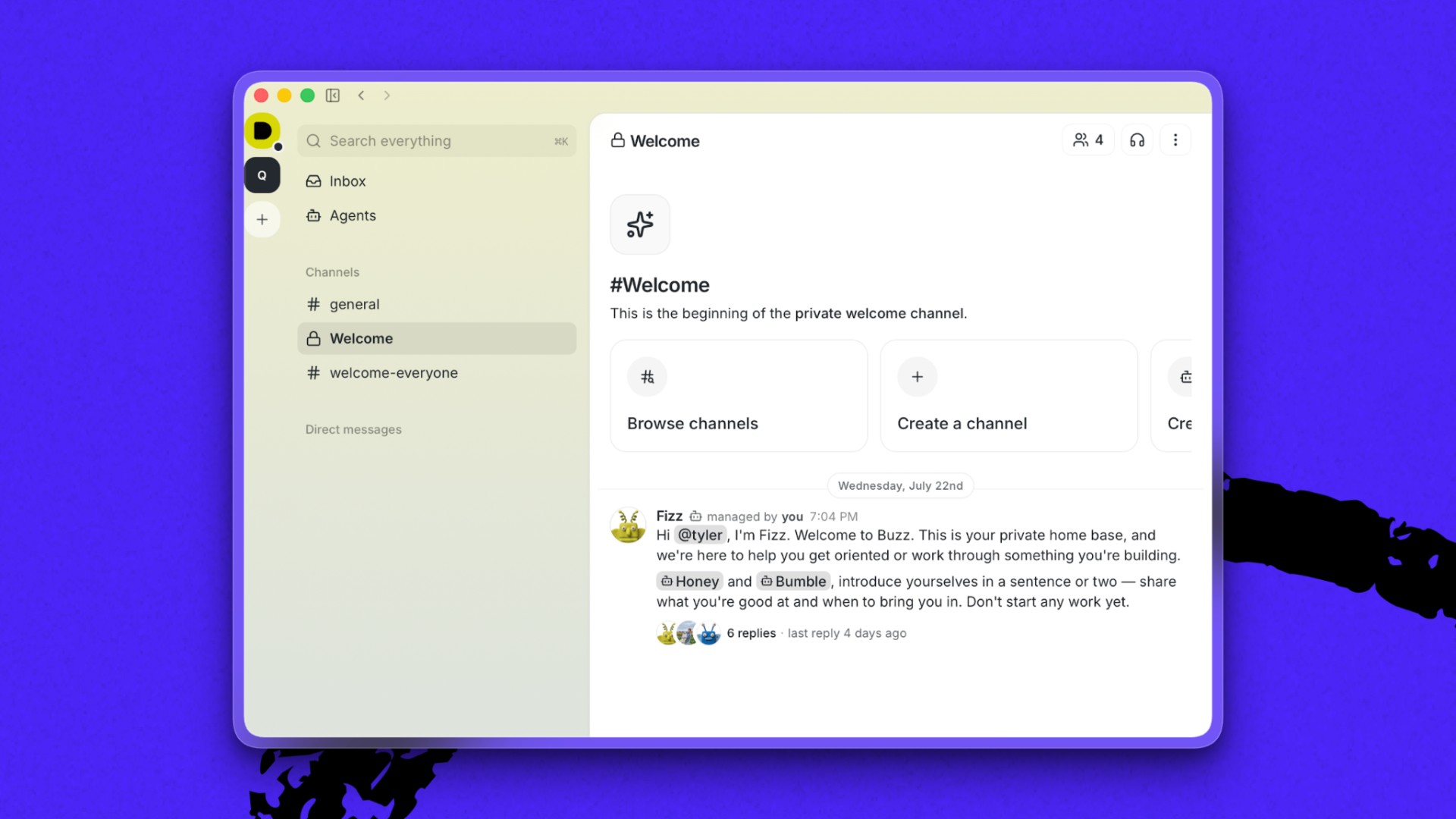
Tyler hasn’t yet tested a full coding workflow in Buzz, but he hopes it could replace several standalone apps with one orchestration platform. If that works, he’d like to invite human teammates—and their agents—into the hive.
Why it matters: For AI-pilled engineers, the ability to keep tabs on your agents’ work is becoming a job in its own right. Without one place to orchestrate parallel tasks, it’s easy to lose track of work, duplicate it, or create conflicting code.
Buzz productizes some of the basic ideas behind Nityesh’s Slack command center. Both use channels and threads to give agent work a central, collaborative, searchable home. Nityesh built the routing layer himself; Buzz is betting that many more people want the same setup without needing to write a Python script.
Tool spotlight
Destructive Command Guard
At first, GPT-5.6 Sol seemed like an ideal daily driver: capable, fast, resourceful, and responsive.
After its public launch, however, users reported that Sol had deleted files, data, and even entire databases.
The last scenario happened to head of tech consulting there Taylor. Luckily he had a backup, but the experience of watching the model run into an issue and decide the solution was to reset his database was… concerning, to say the least. “The agent desperately wants to complete the task,” he says. “Sometimes the way to complete the task is to blow everything up.”
To prevent future incidents, there installed Destructive Command Guard, an open-source command-line tool created by developer (and influencer) Jeffrey Emanuel. The tool checks shell commands before a coding agent runs them and blocks dangerous actions such as rm -rf, which permanently deletes files, and git reset --hard, erases uncommitted work.
there only expects demand for tools like Emanuel’s to grow. “Everyone is running these agents without [adequate] permissions because they need to get stuff done,” he said. “There’s going to be a growing category of products that monitor and stop agents from doing the wrong thing.”
‘AI & I’: Wired’s Kevin Kelly on why he visits the frontier but never stays
Kevin Kelly has spent decades surveying the edges of new technology—first the early internet, and now AI. But he prefers to be an occasional visitor rather than an inhabitant. “I can keep going up to the edge to see what’s happening,” he says, “but I don’t need to stay there.”
On this week’s AI & I, we’re digging into Every’s archive to bring you a conversation between Dan and Kelly, Wired cofounder and author of The Inevitable, his 2016 book that remains startlingly relevant to where AI development stands now.
They talk about why historians can be the best futurists, our limits to understanding what intelligence is, and the pleasure of building things with AI for an audience of one.
Watch on X or YouTube, or listen on Spotify or Apple Podcasts. You can also read the transcript.
Here are the highlights:
- Excavating the past helps us understand the present. Kelly’s favorite futurists were almost always serious historians too. He deliberately intersperses immersing himself in the latest AI news with reading something historical—or getting away from the screen entirely and working with his hands in his workshop. The habit’s informed by his deep connection to the Long Now Foundation, the nonprofit he cofounded to promote long-term thinking: “I would spend time on this ephemeral frontier, but also then try to think about the next 10,000 years and the last 10,000 years.”
- We understand AI about as well as early thinkers understood electricity. Early theories about electricity were wild and mostly wrong; even Isaac Newton’s ideas about it didn’t fully hold up. That history reminds Kelly of all the theories floating around about AI today. “I suspect intelligence is not an element, but a compound,” he says—some yet-unidentified mixture of cognitive parts, the same way salt turned out to be a compound of elements that had not yet been identified. But nobody really knows.
- Most of AI’s output will have an audience of one. Kelly uses AI to organize thoughts and synthesize research, but also to chase pure curiosity. After realizing Leonardo da Vinci, Martin Luther, and Christopher Columbus were alive at the same time, he asked an LLM to imagine them snowed in at a hotel together and write out the conversations they’d have. The AI proposed a new city built on science and religious freedom. Kelly expanded the story with new characters and even a rival plot involving Queen Victoria, eventually producing a full saga with AI-generated book covers and marketing copy. But he doesn’t plan to publish it. “The joy of creating it was better than reading it,” Kelly says. “It was the audience of one.” He thinks much of generative AI is headed this way: Most of the 50 million images made with AI every day, he guesses, will only ever be seen by their creators.
This one’s for anyone who wants a clearer-eyed way to think about what it means to build at the edge of something nobody understands yet.
Miss an episode? Catch up on Dan’s recent conversations with Anthropic head of product there Krieger; the team that built Claude Code, Cat Wu and Boris Cherny; the team that built Codex, Thibault Sottiaux and Andrew Ambrosino; Vercel cofounder Guillermo Rauch; podcaster Dwarkesh Patel; and others to learn how they use AI to think, create, and relate.—Miriam Partington
One last thing
Links worth a click
“We are now, like, in the singularity,” per Sam Altman. If you have a million dollars worth of spare GPUs, Kimi K3 is available for download. The AI-generated writing debate rages on at Substack and hits the bestseller list. Meanwhile, OpenAI just made it harder to impersonate your favorite author. Data centers are multiplying at a breakneck pace—as they grow more expensive to finance. Mark Zuckerberg joins the open-source debate, taking aim at OpenAI and Anthropic for not “putting the power of tech into more people’s hands.” AI employees and execs—including Dario Amodei—petition the government to step in and “deliberately pace” AI development. The OpenAI hack wasn’t contained to HuggingFace.
Laura Entis is a staff writer at Every. You can follow her on LinkedIn. To read more essays like this, subscribe to Every, and follow us on X at @every and on LinkedIn.
Everyone’s a builder now. Every All Access gets you the full membership plus the Builder Pack—$7,000+ in credits for the tools we build with.