|
 |
Thank you for subscribing to Link in Bio! You can always upgrade to a paid subscription here. This newsletter is an educational resource and can likely be expensed through your company—I have even written a template for you to use when asking! For subscription details, see my About page or your account page. You can reply to this email.
The Link in Bio Guide to Freelance Social
How to find clients, calculate rates, write proposals, and set boundaries.
|

| |||||||||||||||


This is the guide that I would have wanted to read when I went out on my own to do freelance social in 2020. I remember Googling “how to write a proposal”. It was bleak. I had no idea how to make money or where to find clients. Turns out basically everyone who goes freelance feels this way.
For this guide, I combined my own experience with anecdotes from other social freelancers who I admire. There’s advice from:
Jeff Meltz, Social Media Strategist and former Global Head of Social at Square and Sony
Christina Roh, Social Media Manager for Sanzo, but freelances for brands like Drumstick
Rania Bolton, Brand Marketing Consultant and former Community + Content Manager at Athena Club
Kendall Dickieson, Founder of Flexible Creative, and has worked with Graza, Canopy, Little Sesame, and more
Dolly Meckler, Head of Digital at Becca, but previously freelanced for clients like Lena Dunham, Netflix, and Hinge
Codi Dantu-Johnson, Freelance Social Media Strategist, who specialized in B2B, higher education, tech, public health, and more
Plus a few other freelancers who chose to remain anonymous.
We cover topics like:
What to do before you go freelance
Types of social media freelance work
Where to find clients
How to set your rate
What to include in a proposal
My audit and strategy deck template
All of the helpful tools
Important advice
Protecting boundaries
How to find community
Before we get into it, I just want to call out that if you enjoy this guide, please consider supporting Link in Bio with a paid subscription. You can learn more about that here. And thank you to Link in Bio paid subscribers for helping make resources like this free and available to everyone!
 |
 |
Do These Things Before You Go Freelance
If you are lucky enough to have a full-time job while you’re preparing to go out on your own, here are a few things I’d recommend doing before you lose your salary.
Start getting a few clients locked in before you leave. Quietly let your network know (via private channels like text or email) that you’re looking to take on some freelance work. Get several irons in the fire before you give notice.
Save up! The worst decisions I made when going freelance were the ones I made under financial scarcity. I’d say try and have 3-6 months of living expenses saved. It takes awhile for those first checks to start rolling in.
Start researching health insurance, LLC or S Corp formation, business banking, and more. Doesn’t necessarily need to be all set up but starting to understand the logistics that go into working for yourself is key.
Prepare your portfolio! (I love this one from Katarina Creative!)
Find a few freelancers who you can be your trusted resources. I can’t tell you how helpful it was to have a few friends who could send me their contract templates or tell me their rates or show me how to send an invoice.
 |
Types of Social Media Freelancing
When I started out freelance, I made a big mistake. I didn’t establish my why. Why do I want to do freelance social vs work for a brand full time? What about social media do I love? What kinds of tasks would I like to get away from? Because of this, I ended up with a some projects I wasn’t passionate about because I didn’t sell my expertise, I simply picked up their slack. After four years, here are some areas you could really hone in on from the jump.
Industry-First Freelancer: Focus your offerings by honing in on helping one specific industry. Become the go-to DTC social consultant like Kendall Dickieson or the B2B whisperer like Tommy Clark. This can help narrow down the types of clients you take on and the work you do.
Platform-Specific Freelancer: Similar to above, but you are known for working on a specific platform. Maybe you’ve built your career creating TikTok strategies or you’re a copywriter that sends the funniest tweets. You can position yourself as someone who can help a brand win on a certain platform. Christina Roh tells me, “Many of the brands I've worked with came to me and said, ‘We just don't understand TikTok. Can you help?’ That's where I usually come in!”
High-Level Social Strategist Freelancer: You come in and work on launches, campaigns, overarching strategy tweaks, and more. You might work on an audit for a brand or put together a campaign deck. You aren’t coming up with evergreen day-to-day posts, you are focused on the higher-level strategy that informs those posts. Jeff Meltz’s consulting work falls into this category and he tells me, “Most of the freelance work I’ve taken on is much more strategically focused (launches, GTM, starting new handles/platforms, campaign advising, etc.)” Here you’re likely working with an existing social team.
Social Media Management Freelancer: This is probably the most common (and most nebulous) type of social freelancer. You’re doing a little bit of everything. You’re coming up with posts, filming TikToks, putting together campaigns, and more. You are basically acting like an employee and helping out on social where needed. Here you might be running an account yourself or working with just one other full-time social employee.
How to Find Clients
I understand my path to freelance is not how it usually goes. I had built a following from Bon Appétit and was lucky enough to be able to spread the word very quickly that I was taking on clients. For this section, I am going to round up the biggest themes I heard from the panel of freelancers I spoke with for this guide:
Word-of-Mouth: Almost every single person said that their best source for finding clients is simply through referrals or word of mouth. Let people know you’re going freelance, tell old colleagues what kind of projects you are working on, and let other freelance social people know you’re open to work. That last point is probably the most important. I get lots of projects that aren’t a fit or that I don’t have bandwidth for that I am so happy to pass along to other social freelancers.
Social Media: Share your work on social platforms like LinkedIn and Twitter. Sometimes it takes sharing a video you worked on or a campaign you oversaw to connect the dots for people that that is what you do.
Thought Leadership: I know I know, but I’ve hard from so many freelancers that writing marketing advice and opinions on LinkedIn or Twitter led to an uptick in client inquiries.
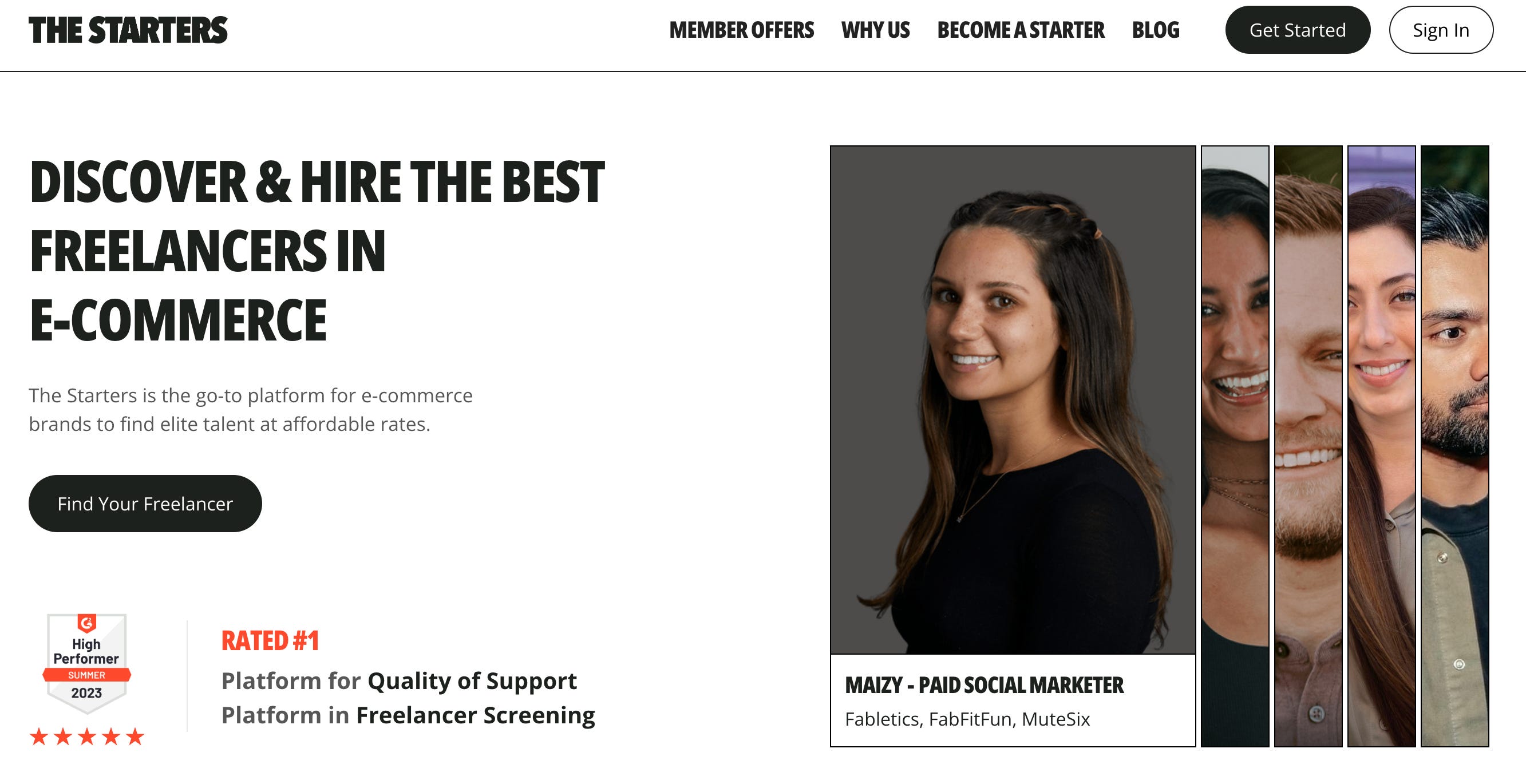
Applying for Contract Roles: Lots of sites put up contract roles, apply to them! I have heard good things about The Starters. When it’s a slower month for referrals, this can be a great place to look.
 |
How to Set Your Rate
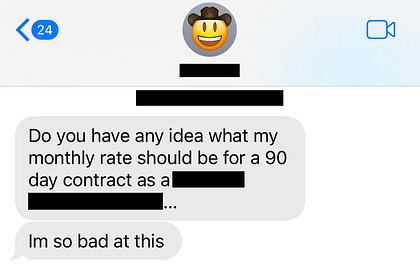
If you’re finding setting your rate hard, welcome to the club. As one freelancer told me, “This is probably one of the most difficult elements of freelancing for me. I just never know what's right! You never want to price yourself too low out of fear that you don't think you're worth that amount, but you also don't want to price yourself too high where you might scare a client (who you really want to work with) away.”
First, let’s start with what kind of rates exist.
Hourly Rate: A set number you charge by the hour
Project Rate: A rate you set up front in a proposal that accounts for what the entire project, which has a start and end date, will cost
Retainer Rate: A rate that is recurring and can be time bound (for example, a client pays you a specific amount per month)
The most helpful thing I did when learning how to set my rates was talk to other freelancers. Rate transparency is so important. I talked to a male freelancer who was charging way more than me and encouraged me to ask for more. A conversation can (and did) change the trajectory of earnings. So, first and foremost, do that. You can also view freelancer rates on sites like Vetted.
Second, you should decide what kind of rate makes sense for the project you are taking on. I, personally, rarely do hourly. I’ll really only do it with clients who want a one-off meeting or advisory services (think: a social pro to call on for advice or troubleshooting). I do a project rate for audits and strategy decks. I do a retainer rate for clients who I work with in an ongoing fashion for more than three months.
Can you tell I’m avoiding giving you a formula for calculating these types of rates? It’s because I am. There’s truly no perfect equation.
Here’s the best I can do:
(What Your Salary Would Be ÷ The 2,080 Working Hours in a Year) x 2 = Your Hourly Rate
You could potentially use that number to then back into project rates and retainers. If you do that, I think you’d still be selling yourself short. That’s why you should really network with other freelancers, ask them what they’d charge for specific projects, and keep tweaking to find a sweet spot that feels good for you.
As one person told me, “It’s a bit of an art. Sometimes I think about how big the client is and what their budget might be. Sometimes I add in a ‘red flag fee’ for potential clients who seem like they might be overbearing or hard to work with based on early conversations. Sometimes I charge more just because the last time I charged that rate, the client accepted a little too quickly. I wish I could say that was more of a science to it.”
How to Write a Proposal
Here is a bare bones proposal template for you! This proposal is more of a strategy project-style template but could be easily tweaked for an hourly role or a retainer. I’ll also typically jazz it up with my brand logo, colors, and fonts. Export as PDF.
You’ll notice I break my work out into phases. I like working this way because it sets helpful milestones and opportunities for feedback. I’m also able to put more accurate timelines when I break out projects this way.
I personally don’t like to combine proposals with actual client agreements, so you may notice this is missing some contractual language. So many clients that reach out will want to see a proposal just to get an idea of how you work and what your rate is. Not every proposal you send out is going to result in a client agreement. At all. I keep my proposals really focused around scope of work so people know what they’d be getting and the cost. We can then talk nitty gritty agreement/contract details once we have a verbal “yes” to move forward.
My Audit and Strategy Template
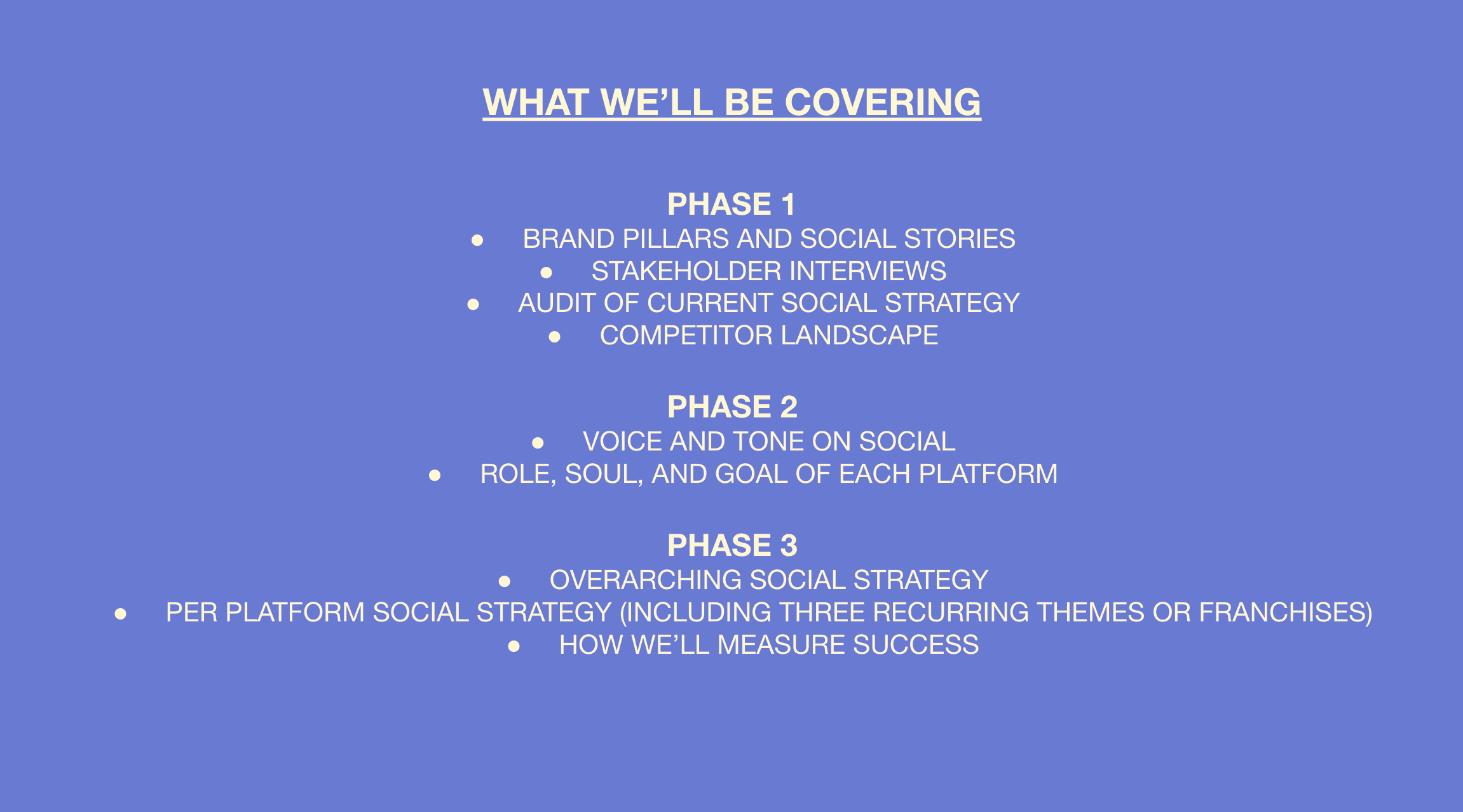
Here is a bare bones audit and strategy template for you! These decks get to be around 50-70 slides once finished, so I won’t bore you with an entire presentation. Here I’ve included a general table of contents and a handful of key slides.
 |
Helpful Tools
I love Quickbooks for all things accounting, invoices, etc. It’s worth it.
I work with a lawyer who helps me with contracts, client agreements, and more. Again, really worth it. If you’re in California and need a referral, email me. This will cost you around $250-$300 an hour but you shouldn’t need to use them that much.
I used LegalZoom to incorporate my company.
Basically every freelancer I talked to loves Google Drive and Google Docs. Same same same.
Codi Dantu-Johnson likes Honeybook for client management—and now I am very intrigued by it.
Honestly I like Canva. I don’t use any of their pre-loaded templates but I basically treat it like Photoshop and it works pretty well.
Get health insurance! I know Quickbooks works with SimplyInsured but do some research and don’t put this off.
Kendall Dickieson hired a Virtual Assistant about 3 years ago who helps her with project management, influencer sourcing (that she vets), and other admin things.
Lots of freelancers really like Asana for both for client and personal project management.
Some Important Advice From Other Freelancers
On Ambiguity: “Be extremely comfortable with ambiguity and know that you may have months where you’re slammed and months where you have nothing to do but chase payments.” - Anon
On imposter syndrome: “Imposter syndrome is REAL! Especially if you came from having a traditional 9-5 where you reported into someone more senior who guided and approved your work. Working freelance can sometimes feel like ‘woah, how am I the one in charge around here?!,’ but try to remember that you are smart, you're good at what you do, and people value your ideas. You wouldn't be getting hired if they didn't!” - Dolly Meckler
On client relationships: “Know that you will come across a ratio of perfect and not-at-all-perfect clients. Focus on being the best possible partner for every client because that’s how you’ll book business in the future. Sometimes, the worst clients have the best networks lol.” - Anon
On a portfolio: “Have a portfolio ready to go, and get detailed! What did you do on the project? How long was the project? Do you have screenshots and reports? Share specific examples. I can't express how critical this is when pitching and winning clients. They want to see your work and thought process.” - Codi Dantu-Johnson
On types of work you take on: “Figure out what you like and what you don't like about social work as you take on different projects, and note what you like! Now that I have more experience and I know what I prefer doing with socials, I can be more careful about which projects I take on.” - Christina Roh
How to Protect Your Boundaries
This section is important. Be overly protective of your time in your contracts and agreements. Outline how many hours the contract covers (think: “this rate is based on up to X hours per week, anything additional is X overtime rate”). Be clear about what exactly your scope is. Say how many rounds of feedback are included. Make sure your client is clear on what you will and will not be doing. Putting these things in writing is important because if a client starts to take advantage of your time or workload, you have something to point to.
I loved this advice from Rania Bolton, “Set strict boundaries around your work (especially if you're hourly), outline your scope through a detailed SOW, manage expectations, and advocate for yourself so you're not getting screwed over by doing more work than what you're being paid for.”
I know it can be uncomfortable to advocate for yourself when consulting. The power dynamic feels off. But if you create a culture of transparency and honesty with your clients, advocating for yourself will be a lot easier. Plus you do have power as a talented freelancer—that’s why the company hired you in the first place.
Finally, Join Social Media Communities
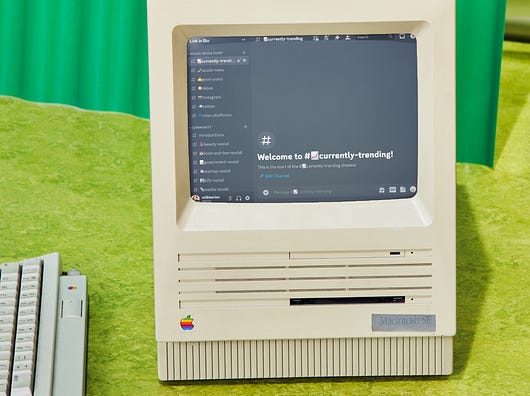
I wasn’t prepared for how lonely I’d feel as a consultant. Having communities where I can talk to other social professionals (whether for fun or for work!) has been immensely helpful. Both LinkedIn and Twitter have been really great for that. Also the Link in Bio Discord (I swear I’m not trying to plug it!) has been wonderful. It’s part of a paid Link in Bio subscription and is so worth it.
Regardless of how you find your community, don’t be afraid to call upon other freelancers for help and advice. Doing that is probably the one thing that has helped my consulting career the most.
 |
 |
Thank you so much for reading! Again, if you liked this guide, please consider supporting Link in Bio with a paid subscription.
Invite your friends and earn rewards
| ||||||||||